
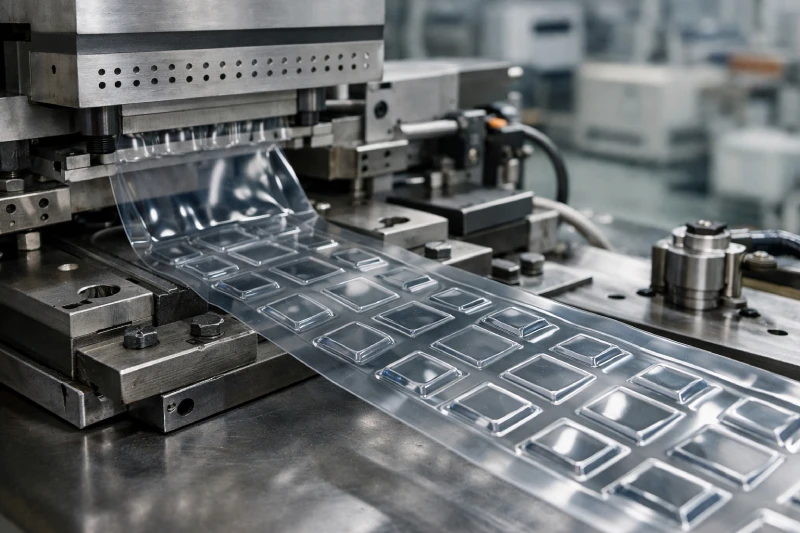
As electronic components continue to trend toward smaller form factors, tighter dimensional tolerances, and higher placement speeds, carrier tape manufacturing has shifted from material supply–driven production to process-controlled engineering.
For embossed carrier tape, thermoforming remains the dominant manufacturing route. Within this category, vacuum forming and pressure forming are the two primary forming technologies used to create pocket geometry. While both rely on heat-softened plastic drawn into a mold, their differences directly affect pocket accuracy, wall definition, repeatability, and long-run process stability.
Understanding these differences matters not from a marketing standpoint, but because forming choice influences downstream risks such as component misalignment, pick-and-place instability, and feeder compatibility.
Technical Challenge
The core technical challenge in carrier tape forming is reproducing consistent pocket geometry at scale while maintaining:
- Controlled pocket depth and pitch
- Stable sidewall angles
- Uniform material thickness distribution
- Minimal residual stress after cooling
As pocket geometries become deeper, narrower, or more asymmetrical, the forming method must overcome limitations in material flow, air evacuation, and mold contact fidelity. The choice between vacuum forming and pressure forming directly impacts how well these constraints are managed.
Implications for Carrier Tape & Packaging
Vacuum forming relies on negative pressure to draw heated film into the mold cavity. It is mechanically simpler and suitable for:
- Shallow to moderate pocket depths
- Symmetrical or forgiving geometries
- Applications where tolerance windows are wider
However, vacuum-only force limits how closely the softened material conforms to sharp corners or vertical walls. This can lead to:
- Rounded pocket corners
- Reduced bottom definition
- Higher variability at deeper draw ratios
Pressure forming, by contrast, applies positive air pressure above the sheet, forcing material more aggressively into mold details. This has direct implications for carrier tape used in high-precision SMT applications:
- Sharper pocket definition
- More accurate depth control
- Improved wall consistency across long runs
These differences influence not only pocket shape, but also component seating stability and cover tape sealing behavior.
Engineering Considerations
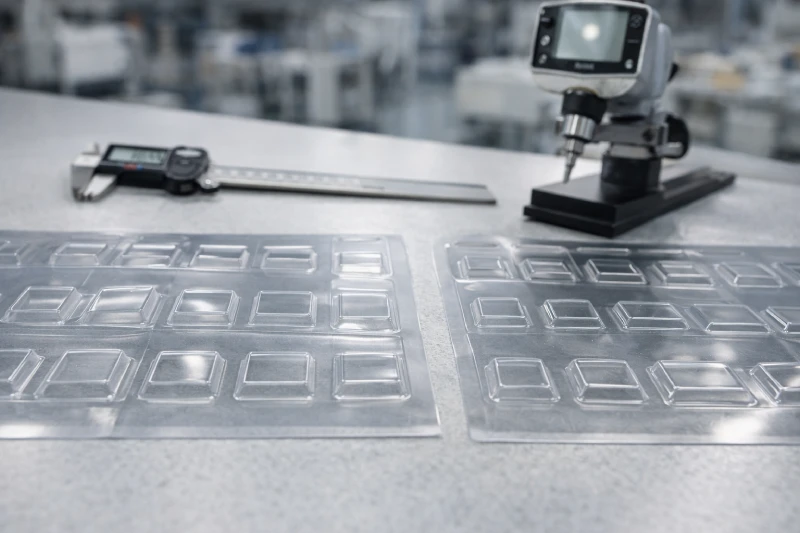
From an engineering standpoint, the forming method must be evaluated together with tooling and material behavior, not in isolation.
Key considerations include:
- Tooling design
Pressure forming typically requires tighter mold tolerances, improved venting strategies, and more robust tooling materials to withstand repeated pressurization cycles. - Material selection
PET, PS, PC, and anti-static compounds respond differently to forming forces. Pressure forming enables better replication of mold detail but also amplifies sensitivity to temperature control and sheet thickness variation. - Process window control
Pressure forming narrows the acceptable temperature and pressure range. While this improves accuracy, it demands higher process discipline and monitoring. - Repeatability over volume
For high-volume programs, pressure forming offers better long-term dimensional stability, provided tooling wear and pressure consistency are actively managed.
How Manufacturers Address This
Experienced carrier tape manufacturers do not treat vacuum and pressure forming as interchangeable options. Instead, they typically:
- Match forming technology to component geometry complexity, not just cost
- Use vacuum forming for standardized, high-tolerance products where scalability outweighs precision
- Apply pressure forming for custom or tight-tolerance programs requiring higher pocket fidelity
- Invest in mold validation, first-article measurement, and forming trials before committing to volume production
- Combine forming method selection with in-process inspection and statistical control to maintain consistency over time
In practice, the forming method becomes part of a broader engineering decision chain, rather than a standalone manufacturing choice.
Related Packaging Solutions
The forming technology selected directly influences the performance and suitability of related packaging solutions, including:
- carrier tape systems where forming accuracy impacts feeder reliability
- embossed carrier tape requiring defined pocket geometry for automated placement
- anti-static carrier tape where material behavior under pressure must align with ESD performance
- custom embossed carrier tape programs where pressure forming often enables tighter design control
Each solution benefits differently depending on how forming force, tooling precision, and material response are engineered together.
In carrier tape manufacturing, the question is not whether vacuum or pressure forming is “better,” but which process delivers the required dimensional stability, repeatability, and scalability for a given component and production environment.