
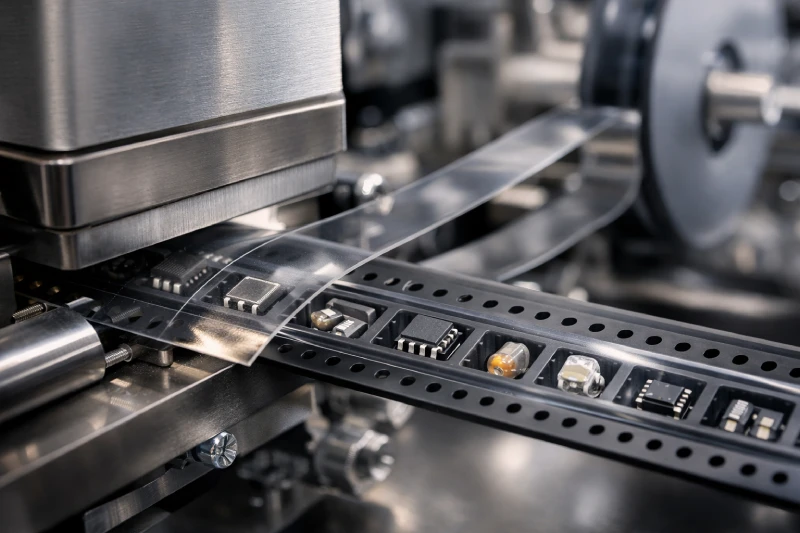
SMT cover tape is one of the most important yet overlooked materials in tape and reel packaging. While carrier tape holds the components in place, cover tape seals the pockets and keeps every part secure until it reaches the SMT production line. If the wrong cover tape is used, components may shift, fall out, generate static, or cause feeder jams during assembly.
For SMT manufacturers, electronics assemblers, and procurement teams, selecting the correct cover tape directly affects packaging reliability, shipping safety, and machine efficiency. This guide explains how SMT cover tape works, the difference between heat activated and pressure sensitive cover tape, what peeling force means, and how to choose the right solution for your components.
What Is SMT Cover Tape?
SMT cover tape is a thin film applied over carrier tape to seal electronic components inside each pocket during tape and reel packaging. After components are loaded into the carrier tape, the cover tape is laminated across the top, creating a closed package that protects parts during storage, shipping, and automated feeding.
SMT cover tape is commonly used for:
- ICs and semiconductors
- LEDs
- Resistors and capacitors
- Connectors
- Sensors
- Small precision electronic parts
Unlike carrier tape, which provides the pocket structure, cover tape provides the sealing function. Both materials must work together to ensure stable performance.
For a more detailed overview of cover tape materials and available formats, readers can also review the dedicated Cover Tape product page and the Tape & Reel Packaging solutions page.
How SMT Cover Tape Works in Tape and Reel Packaging
During the packaging process, components are first placed into embossed carrier tape pockets. A sealing machine then applies SMT cover tape across the top. Depending on the tape type, the cover tape is attached either by heat and pressure or by direct adhesive contact.
When the reel is loaded into the SMT feeder, the machine peels the cover tape back at a controlled angle. The components remain in the carrier tape until they reach the pick-and-place position, where they are removed one by one.
If the cover tape peels too easily, parts may escape. If it is too strong, the feeder may stop or components may jump out of the pockets.
Why SMT Cover Tape Is Critical for SMT Production
Many SMT packaging problems are caused not by the components themselves, but by unstable cover tape performance. Poor sealing can lead to missing parts, feeder jams, increased downtime, and expensive production delays.
A properly selected SMT cover tape provides several benefits:
| Without Proper Cover Tape | With Proper SMT Cover Tape |
|---|---|
| Components can fall out during transport | Components remain secure inside the pockets |
| Dust and moisture can contaminate parts | Components stay protected |
| Feeder jams and pick-up errors occur | Smooth automatic feeding |
| Higher reject rate and machine downtime | Stable SMT production and better yield |
For high-speed SMT lines running tens of thousands of components per hour, even a small issue with cover tape can create significant losses. If the cover tape breaks, lifts, or peels inconsistently, the feeder may stop and operators must manually reload the reel.
This is especially important for delicate ICs, semiconductor packages, and small passive components. These parts are often lightweight and can easily move inside the pocket if the cover tape is not properly matched.
In short, SMT cover tape is not just a packaging material. It is a key part of overall production reliability.
Types of SMT Cover Tape
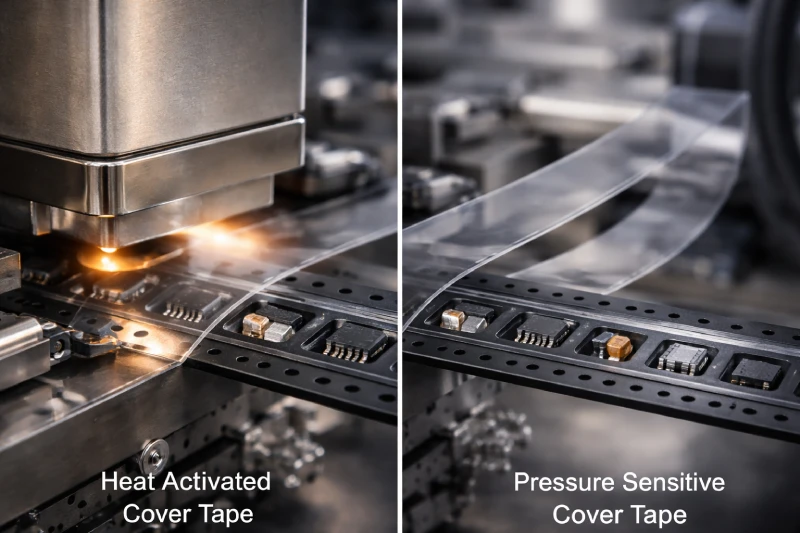
The two most common SMT cover tape types are heat activated cover tape and pressure sensitive cover tape. Each type has different sealing methods, equipment requirements, and applications.
Heat Activated Cover Tape
Heat activated cover tape requires heat and pressure during the sealing process. A heated sealing head bonds the cover tape to the carrier tape, creating a strong and consistent seal.
This type of cover tape is widely used in:
- Semiconductor packaging
- IC and QFN packaging
- High-speed SMT production
- Long-distance export shipments
- Applications with strict peel force requirements
The main advantage of heat activated cover tape is stability. Because the seal is formed by heat, the bond is generally stronger and more consistent than pressure sensitive alternatives. It is less likely to lift during shipping or fail during automated feeding.
Heat activated tape is often recommended for demanding applications where production volume is high and failure risk must be minimized.
For more technical specifications, readers can review the Heat Activated Cover Tape product page.
Pressure Sensitive Cover Tape
Pressure sensitive cover tape uses adhesive to bond directly to the carrier tape without heat. It is easier to apply and does not require specialized sealing equipment.
This type is commonly used for:
- Small production runs
- Manual or semi-automatic packaging
- Lower-volume electronic products
- Situations where flexibility and quick setup are important
Because no heating system is needed, pressure sensitive cover tape can reduce equipment costs and simplify production. However, its sealing strength is usually lower than heat activated cover tape, especially in hot or demanding shipping environments.
For additional details, refer to the Pressure Sensitive Cover Tape page.
Heat Activated vs Pressure Sensitive Cover Tape
| Feature | Heat Activated Cover Tape | Pressure Sensitive Cover Tape |
|---|---|---|
| Sealing Method | Heat + pressure | Adhesive only |
| Equipment Needed | Sealing machine with heat | No heating equipment |
| Seal Strength | Strong and stable | Moderate |
| Best For | High-volume SMT production | Small batches and flexible packaging |
| Shipping Resistance | Better for long transport | Better for short-term use |
| Typical Application | ICs, semiconductors, high-speed feeders | Prototypes, small components, manual packing |
In most industrial SMT applications, heat activated cover tape is the preferred choice because it offers better consistency and lower risk during automatic feeding.
SMT Cover Tape Materials and Structure
SMT cover tape is usually made from multi-layer polyester or PET film. The exact structure varies depending on the component type, peel force requirement, and whether ESD protection is needed.
A typical SMT cover tape includes three layers:
- Base film layer
- Adhesive or heat-seal layer
- Anti-static or conductive coating
The base film is usually transparent PET or polyester. Transparency is important because it allows operators to inspect the components inside the carrier tape pockets without opening the reel.
The adhesive layer controls the peel strength and determines whether the cover tape is heat activated or pressure sensitive.
The outer coating may include anti-static or conductive properties to protect sensitive components from electrostatic discharge.
Anti-Static SMT Cover Tape for Sensitive Components
Many semiconductors, ICs, and LEDs are vulnerable to static electricity. Even a small electrostatic discharge can damage the component internally before it reaches the SMT line.
To prevent this, manufacturers often use anti-static SMT cover tape together with anti-static carrier tape. These materials dissipate electrical charges and reduce the risk of ESD damage.
If you package ICs, semiconductor devices, or other sensitive parts, using ESD-safe cover tape is strongly recommended. Matching the cover tape with Anti-Static Carrier Tape provides the best protection.
SMT Cover Tape Peeling Force Explained
Peeling force refers to the amount of force required to remove the cover tape from the carrier tape during SMT feeding. It is one of the most important performance indicators for SMT cover tape.
If the peeling force is too low:
- The cover tape may lift during transportation
- Components may fall out of the pockets
- Dust or contamination can enter the reel
If the peeling force is too high:
- The cover tape may snap during feeding
- The feeder may stop or jam
- Small components may jump out of the pocket during peel-off
Industry standards such as EIA-481 define acceptable peel force ranges and peel angles for tape and reel packaging. In most cases, the cover tape is peeled at approximately 165° to 180° during SMT feeding.
Typical peel force depends on:
- Carrier tape width
- Component size and weight
- Cover tape type
- Feeder speed
- Temperature and storage conditions
| Problem | Likely Cause |
|---|---|
| Missing components in pockets | Peel force too low |
| Cover tape breaks during feeding | Peel force too high |
| Component movement during peel-off | Poor compatibility between carrier tape and cover tape |
| Unstable feeder performance | Inconsistent sealing quality |
Typical SMT Cover Tape Peel Force Range
Most SMT cover tape products are designed within a standard peel force range suitable for automatic feeders. However, there is no single ideal value for every application.
Small lightweight components often require lower peel force, while larger ICs or deeper pockets may require stronger sealing. Before mass production, it is always best to request peel force test data and run compatibility trials with your own carrier tape and feeder equipment.
Common SMT Cover Tape Problems and How to Prevent Them
Even good cover tape can create problems if it is not used correctly. Below are the most common SMT cover tape issues and how to avoid them.
Cover Tape Does Not Seal Properly
Possible causes include:
- Incorrect sealing temperature
- Wrong sealing pressure
- Incompatible carrier tape material
- Dirty or contaminated carrier tape surface
Solution: Verify sealing parameters and test the cover tape with the exact carrier tape before production.
Cover Tape Lifts During Transportation
This problem usually occurs when the adhesive strength is too weak or the reel is exposed to vibration and high temperature during shipping.
Solution: Use stronger heat activated cover tape for export shipments or long storage periods.
Cover Tape Breaks During SMT Feeding
If the peel force is too high, the tape may tear during automatic feeding.
Solution: Reduce the sealing temperature, adjust the peel angle, or switch to a more suitable cover tape.
Static Electricity Damages Components
When non-ESD-safe cover tape is used with sensitive semiconductors, static charges can accumulate.
Solution: Use anti-static cover tape together with ESD-safe carrier tape.
Additional best practices include:
- Store reels in stable temperature and humidity
- Avoid direct sunlight
- Test reels before mass production
- Use the same supplier for carrier tape and cover tape whenever possible
How to Choose the Right SMT Cover Tape
The best SMT cover tape depends on your component type, production process, and shipping conditions.
Use the following checklist when selecting cover tape:
| If You Need… | Recommended SMT Cover Tape |
|---|---|
| High-speed automated SMT production | Heat activated cover tape |
| Sensitive IC or semiconductor packaging | Anti-static SMT cover tape |
| Small production run or prototype | Pressure sensitive cover tape |
| Long-distance export shipment | Strong heat activated tape |
| Visual inspection of components | Transparent PET cover tape |
You should also consider:
- Carrier tape width and pocket design
- Required peel force
- SMT feeder speed
- Storage time before assembly
- Whether the component requires ESD protection
- Packaging volume and sealing equipment
For example, if you package ICs for export and use high-speed pick-and-place machines, a heat activated anti-static cover tape is usually the best solution.
If you are still unsure, working with a supplier that offers both carrier tape and cover tape can simplify the selection process.
Why Compatibility Between Carrier Tape and SMT Cover Tape Matters
Not every SMT cover tape works with every carrier tape. Differences in material, surface finish, width, and adhesive properties can affect sealing quality and peel force.
Even if both materials meet standard specifications individually, they may not perform well together. A cover tape with excellent peel force on one carrier tape may become too strong or too weak on another.
For the best results, carrier tape and cover tape should be tested as a matched system. Using the same supplier for both materials often improves compatibility and reduces troubleshooting.
If your components require unusual pocket depth, custom widths, or special ESD performance, consider using a Custom Carrier Tape solution together with a matched SMT cover tape.
FAQs About SMT Cover Tape
What is the difference between SMT cover tape and carrier tape?
Carrier tape forms the pockets that hold the components. SMT cover tape seals the top of the carrier tape to keep the components inside.
Can pressure sensitive cover tape be used for high-speed SMT lines?
In some cases, yes. However, heat activated cover tape is usually more reliable for high-speed automatic feeding because it provides stronger and more consistent sealing.
What is the standard peel force for SMT cover tape?
There is no universal value. The correct peel force depends on the component size, carrier tape width, and feeder speed. Most suppliers follow EIA-481 guidelines.
How should SMT cover tape be stored?
Store SMT cover tape in a cool, dry environment away from sunlight and humidity. Stable storage conditions help maintain consistent peel force.
Do all SMT cover tapes provide ESD protection?
No. Only anti-static or conductive SMT cover tapes provide ESD protection. Standard PET cover tape may not protect sensitive electronic components.
Conclusion
SMT cover tape plays a critical role in tape and reel packaging and directly affects SMT production reliability. The correct cover tape prevents component loss, protects against contamination and static, and ensures smooth automatic feeding.
When choosing SMT cover tape, pay close attention to sealing method, peel force, ESD requirements, and compatibility with the carrier tape. For demanding SMT applications, heat activated anti-static cover tape is often the safest and most reliable option.
Not sure which SMT cover tape matches your carrier tape or components? Send us your component drawing, carrier tape specification, or reel sample, and we can recommend the best heat activated or pressure sensitive SMT cover tape solution for your production line.