
Non-standard tape format
Tape width/thickness, total length, or rigidity creates unstable winding or flange interference

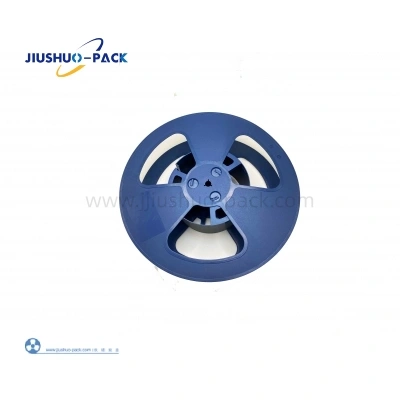
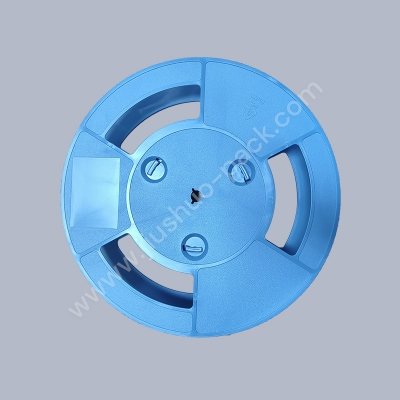
Custom plastic reels are developed for tape-and-reel projects where standard EIA-481 reels are not suitable due to dimensional, structural, or process-related constraints.
Instead of selecting from predefined sizes, custom reel projects start with application requirements—including carrier tape format, winding length, equipment interface, and handling conditions—and translate them into a feasible reel structure.
These solutions are typically used in cases involving non-standard tape widths, special hub interfaces, unique assembly methods, or integration with specific packaging or feeding equipment.
The focus is not on catalog selection, but on engineering validation, production feasibility, and long-term stability.
Standard EIA-481 reels are designed around fixed hub and flange interfaces. They work well for mainstream carrier tape formats, but become limiting when tape structure, equipment interface, or handling conditions deviate from standard assumptions.
If your project requires a different winding behavior, mounting method, or mechanical support level, a custom reel is typically the more reliable path—because it resolves compatibility at the interface level, not by forcing a near-fit.
Custom plastic reel development focuses on adapting key mechanical interfaces and structural parameters to match non-standard tape-and-reel requirements.
Customization is applied selectively—only where it improves compatibility, stability, or process efficiency.
To ensure feasibility and production reliability, each design is evaluated within defined technical and tooling boundaries.
Adjusted to match tape length, pocket depth, or handling constraints
Inner diameter, hub depth, mounting or locking features
Thickness, reinforcement geometry, or load-bearing support
Rotary, snap-on, or integrated constructions for operational efficiency
Mechanical strength, weight, or environmental stability considerations
Extremely small dimensional changes may still require new tooling
Increased reel size or strength may affect weight and handling
Not all materials perform equally under high load or repeated reuse
Low-volume projects may face higher per-unit tooling impact
Custom reels must still interface reliably with carrier tape and equipment
Custom reel projects move forward through a structured process that validates design feasibility, tooling suitability, and functional performance before production commitment.
Project requirements are reviewed to identify non-standard tape, winding, or equipment interface constraints before design begins.
A preliminary reel structure is defined and evaluated to confirm tooling feasibility and mechanical stability.
Prototype reels are produced to verify dimensional accuracy and interface compatibility.
Reels are tested with carrier tape to confirm stable winding, handling, and unwind behavior.
Validated samples are approved for production planning and scalability preparation.
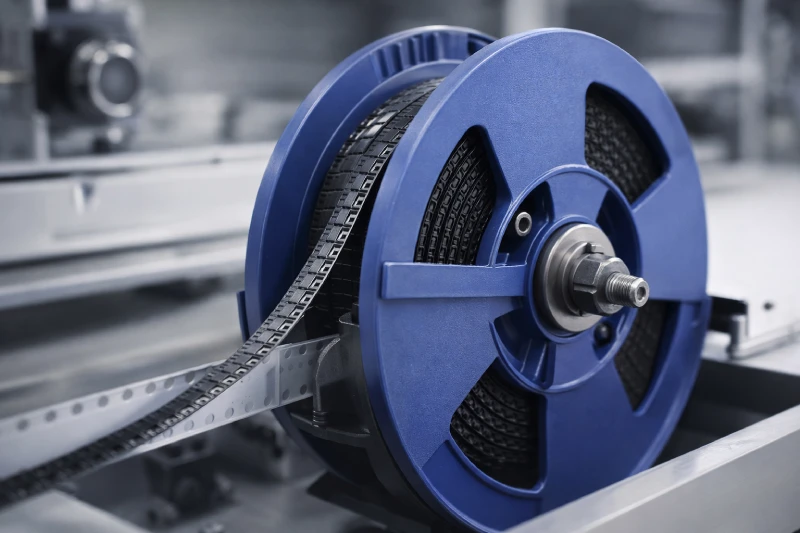
Hub, flange, and interface dimensions remain stable across samples
Tape tension, alignment, and peel stability during operation
Flange strength and hub durability under load and repeated use
Reliable mounting and rotation on intended winding and feeding equipment
Ability to maintain critical tolerances in volume production
Consistent mechanical performance across batches
Suitability for manual or automated assembly processes
Defined inspection criteria for ongoing production
To evaluate feasibility and avoid redesign cycles, a small set of application details is required before custom reel development begins.
Custom plastic reel projects follow a coordinated workflow to align engineering review, tooling preparation, sampling, and production planning.
| Stage | Typical Lead Time | Notes |
|---|---|---|
| Engineering review & design confirmation | 2–4 working days | After receiving complete requirements and interface details. |
| Tooling preparation | 7–15 working days | Depends on reel geometry, material choice, and tooling scope. |
| Prototype sampling | 3–7 working days | After tooling is ready; focuses on dimensional and interface accuracy. |
| Validation & approval cycle | 5–10 working days | Varies with testing scope and feedback/approval turnaround. |
| Mass production | 10–20 working days | After final sample approval and production schedule confirmation. |
Throughout the project, lead time is managed through:
Requirement completeness check: Incomplete inputs are flagged early to avoid downstream delays
Milestone-based progress updates: Design, tooling, sampling, and approval stages clearly separated
Change impact review: Timeline adjustments communicated before implementation
Approval alignment: Each phase proceeds only after confirmation to prevent rework