

Introduction
In electronic manufacturing, moisture is an invisible but critical threat. From semiconductor ICs to precision automotive components, even small amounts of humidity can lead to oxidation, delamination, or catastrophic failures during reflow soldering. While most manufacturers focus on electrostatic discharge (ESD) protection, moisture-related risks are often underestimated—until defects appear in production.
This is where moisture resistant carrier tape becomes essential. Designed to minimize moisture absorption and maintain dimensional stability in humid environments, it plays a key role in ensuring reliable SMT (Surface Mount Technology) processes.
Whether you are packaging sensitive ICs or shipping components across high-humidity regions, choosing the right carrier tape can directly impact product quality and yield. In this guide, we’ll explain how moisture resistant carrier tape works, when you need it, and how to select the right solution for your application.
What Is Moisture Resistant Carrier Tape?
Moisture resistant carrier tape is a specialized type of carrier tape engineered to reduce moisture absorption and maintain structural integrity under humid conditions. It is typically made from modified materials such as PET or treated PS that offer lower hygroscopic properties compared to standard tapes.
Unlike standard carrier tape, which may absorb moisture and deform over time, moisture resistant versions are designed to:
- Minimize water absorption
- Maintain pocket dimensions in high humidity
- Protect sensitive electronic components during storage and transport
For a broader understanding of carrier tape fundamentals, you can refer to our detailed guide on carrier tape basics.
In short, moisture resistant carrier tape is not just packaging—it is a reliability control layer in modern electronics manufacturing.
Why Moisture Control Is Critical in Electronic Packaging
Moisture can have serious consequences in electronic packaging, especially for moisture-sensitive devices (MSDs). The risks are not always visible immediately, but they can lead to significant failures during assembly.
Key Risks of Moisture Exposure
- Popcorning effect: Moisture trapped inside IC packages expands rapidly during reflow, causing internal cracks or delamination
- Oxidation: Metal leads and contacts may corrode, affecting conductivity and solderability
- Reduced ESD performance: Moisture can alter the electrostatic properties of packaging materials
- Dimensional instability: Tape deformation can lead to feeding errors in SMT machines
These risks are closely related to the Moisture Sensitivity Level (MSL) classification of components. Higher MSL levels require stricter moisture control during storage and handling.
In high-humidity regions or during sea freight transportation, standard packaging solutions often fall short. Moisture resistant carrier tape provides an additional layer of protection that helps maintain product integrity throughout the supply chain.
Key Features of Moisture Resistant Carrier Tape
To effectively control moisture-related risks, moisture resistant carrier tape incorporates several engineering features.
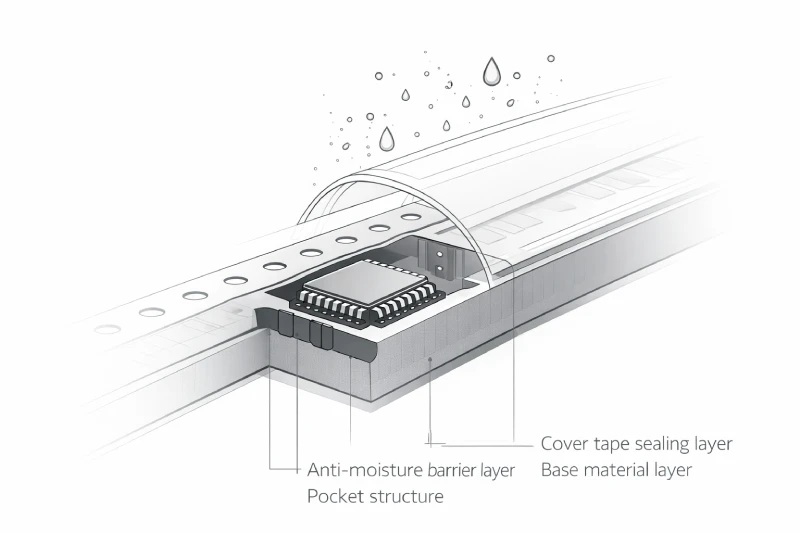
Low Moisture Absorption Materials
Moisture resistant tapes are typically made from materials such as PET or specially modified PS. These materials have significantly lower water absorption rates compared to conventional plastics.
- Standard PS: higher moisture uptake
- Modified PS / PET: reduced hygroscopic behavior
This ensures that the tape remains stable even after prolonged exposure to humid environments.
Dimensional Stability Under Humidity
One of the most critical requirements in SMT packaging is consistent pocket geometry. Moisture can cause expansion or warping in standard tapes, leading to:
- Misalignment during feeding
- Component tilting or flipping
- Increased pick-and-place errors
Moisture resistant carrier tape maintains its shape, ensuring smooth operation in high-speed SMT lines.
Compatibility with Moisture Barrier Packaging
Moisture resistant carrier tape is designed to work seamlessly with:
- Moisture Barrier Bags (MBB)
- Desiccants
- Humidity indicator cards
This combination provides a complete moisture control system, especially for long-term storage or international shipping.
Anti-Static and Conductive Options
In many applications, moisture protection must be combined with electrostatic control. Moisture resistant carrier tapes are available in:
- Anti-static versions
- Conductive versions
If your application also requires ESD protection, you can explore our guide on anti-static carrier tape solutions.
This dual-function approach is essential for high-reliability electronics manufacturing.
Moisture Resistant vs Standard Carrier Tape
Understanding the difference between moisture resistant and standard carrier tape helps you make the right decision for your application.
| Feature | Moisture Resistant Carrier Tape | Standard Carrier Tape |
|---|---|---|
| Moisture Absorption | Low | Moderate to High |
| Dimensional Stability | High | Medium |
| Risk of Component Damage | Low | Higher |
| Application | Sensitive components, export | General use |
| Cost | Higher | Lower |
Key takeaway: For high-value or moisture-sensitive components, moisture resistant carrier tape is not optional—it is essential.
Applications of Moisture Resistant Carrier Tape
Moisture resistant carrier tape is widely used in industries where environmental control is critical.
Semiconductor & IC Packaging
Integrated circuits are highly sensitive to moisture, especially those with high MSL ratings. Moisture resistant carrier tape helps prevent internal damage during reflow processes.
Automotive Electronics
Automotive components must meet strict reliability standards. Exposure to moisture can compromise long-term performance, making moisture-resistant packaging a necessity.
LED Components
LEDs are sensitive to both moisture and thermal stress. Proper packaging ensures consistent optical and electrical performance.
Export Packaging (Sea Freight & Long Storage)
Shipping components across humid regions or storing them for extended periods increases moisture exposure risk. Moisture resistant carrier tape provides stability throughout the logistics process.
How to Choose the Right Moisture Resistant Carrier Tape
Selecting the right carrier tape requires a systematic evaluation of your application. Here is a practical checklist:
1. Component Sensitivity (MSL Level)
Higher MSL components require stronger moisture protection.
2. Storage and Shipping Conditions
Consider:
- Humidity levels
- Storage duration
- Transportation method (air vs sea)
3. Material Type
Choose from:
- PS (cost-effective)
- PET (higher stability)
- PC (high-end applications)
4. Pocket Design and Dimensions
Ensure precise fit to avoid movement or damage.
5. Compatibility with Cover Tape
Proper sealing is critical. Learn more about cover tape compatibility.
6. Compliance with Industry Standards
Ensure the tape meets EIA-481 requirements for SMT packaging.
Pro Tip (CTA):
For critical applications, a custom-designed carrier tape solution based on your component and environment is highly recommended. Engineering support can significantly reduce risk and improve efficiency.
Common Mistakes to Avoid
Even experienced manufacturers can overlook key factors when dealing with moisture-sensitive packaging.
- Focusing only on ESD protection while ignoring moisture risks
- Using standard PS tape for high-MSL components
- Skipping moisture barrier packaging
- Storing components in uncontrolled environments
- Ignoring long shipping durations
Avoiding these mistakes can prevent costly production failures and improve overall yield.
Moisture Resistant Carrier Tape + Complete Packaging Solution
Moisture resistant carrier tape works best as part of a complete tape-and-reel packaging system, including:
- Carrier tape
- Cover tape
- Plastic reel
- Moisture barrier bag (MBB)
- Desiccants
This integrated approach ensures maximum protection from production to final assembly.
👉 Need a complete solution?
We provide custom carrier tape design, sampling, and full packaging solutions tailored to your components and production requirements.
- Request a free sample
- Get engineering consultation
- Optimize your SMT packaging process
FAQ
What is moisture resistant carrier tape made of?
It is typically made from PET or modified PS materials with low moisture absorption properties.
Do all carrier tapes need moisture protection?
No, but it is essential for moisture-sensitive components such as ICs and semiconductors.
How should carrier tape be stored in humid environments?
Use moisture barrier bags, desiccants, and controlled storage conditions to minimize exposure.
Is moisture resistant tape necessary for IC chips?
Yes, especially for components with higher MSL ratings.
Can moisture resistant carrier tape also be anti-static?
Yes, many options combine moisture resistance with anti-static or conductive properties.
Conclusion
Moisture is a critical factor that can silently compromise electronic components and manufacturing processes. As devices become more sensitive and supply chains more complex, relying on standard packaging is no longer sufficient.
Moisture resistant carrier tape provides a reliable solution by minimizing moisture absorption, maintaining dimensional stability, and protecting sensitive components throughout storage and transport.
If you are dealing with high-value electronics or challenging environmental conditions, investing in the right carrier tape solution is not just a technical choice—it is a strategic one.
👉 Ready to upgrade your packaging?
Contact us today for customized moisture resistant carrier tape solutions designed for your exact application.