
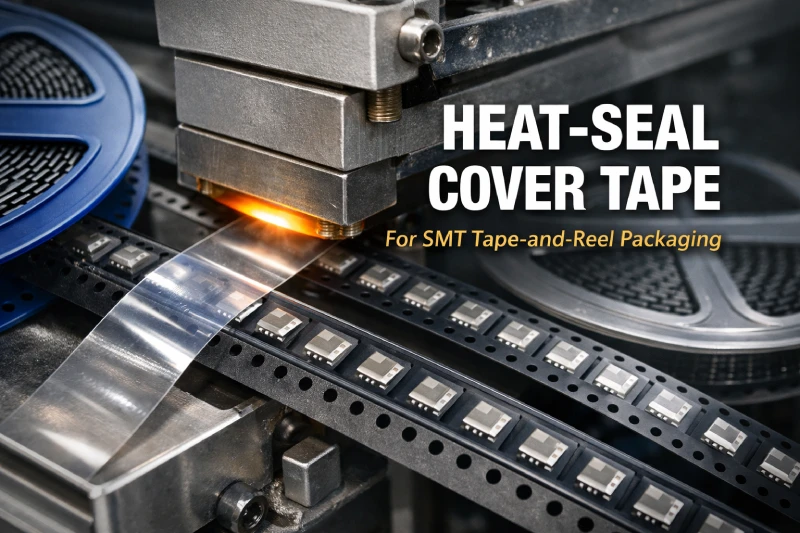
Heat-seal cover tape is one of the most important materials used in SMT tape-and-reel packaging. It seals electronic components inside carrier tape pockets, protecting them during storage, shipping, and automated assembly.
Compared with pressure-sensitive cover tape, heat-seal cover tape creates a more stable and consistent bond. That is why it is commonly used for ICs, LEDs, chip resistors, connectors, sensors, and other sensitive components that require reliable feeding on high-speed SMT lines.
If the seal is too weak, components can fall out during transport. If the peel force is too high, the cover tape may not peel smoothly in the feeder. Choosing the correct heat-seal cover tape therefore affects packaging quality, pick-and-place efficiency, and overall production yield.
In this guide, you will learn how heat-seal cover tape works, what materials are available, how it compares with pressure-sensitive cover tape, and how to choose the right option for your packaging application.
What Is Heat-Seal Cover Tape?
Heat-seal cover tape is a thin sealing film designed to close the top of carrier tape after components are loaded into the pockets. During the packaging process, the cover tape is applied to the flange area of the carrier tape using heat and pressure.
The purpose of the tape is simple: keep every component securely inside the pocket until it reaches the SMT pick-and-place machine.
Heat-seal cover tape is widely used in:
- Semiconductors and IC packaging
- LEDs and optoelectronic devices
- Chip resistors and capacitors
- Connectors and sensors
- Automotive and medical electronics
Unlike standard adhesive tapes, heat-seal cover tape uses a heat-activated coating on the bottom layer. When the sealing head reaches the correct temperature, the coating bonds to the carrier tape surface and creates a strong but controlled seal.
This type of cover tape is often paired with embossed carrier tape because embossed pockets provide precise positioning for small components. If you want to understand the full relationship between these materials, see our guide to carrier tape and embossed carrier tape.
How Heat-Seal Cover Tape Works
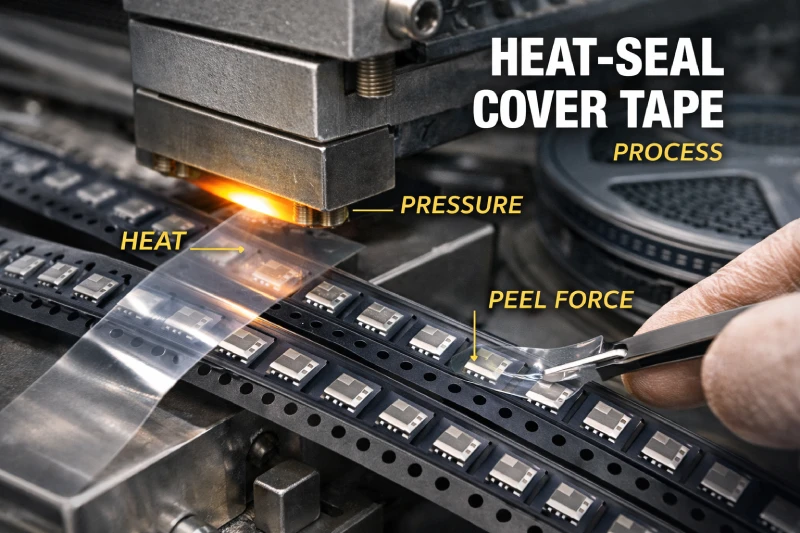
The sealing process takes place immediately after components are loaded into the carrier tape. A sealing machine aligns the cover tape over the carrier tape and applies controlled heat and pressure.
The heat activates the adhesive layer, while the pressure ensures full contact across the flange area. Once cooled, the cover tape remains firmly attached during shipping and reel handling.
Later, when the reel is installed on the SMT feeder, the cover tape peels away at a controlled angle and force, allowing each component to be removed smoothly.
Why It Is Used in SMT Packaging
Heat-seal cover tape is popular because it improves feeding reliability and reduces packaging failures.
Its main benefits include:
- Preventing components from shifting inside the pocket
- Reducing component loss during transportation
- Improving consistency on high-speed SMT lines
- Lowering the risk of feeder jams and production downtime
For most automated production environments, especially those handling small or sensitive components, heat-seal cover tape is considered the more reliable option.
Main Structure and Materials of Heat-Seal Cover Tape
Although heat-seal cover tape looks simple, it is usually made from several functional layers.
A typical heat-seal cover tape includes:
- A top PET film layer
- An optional anti-static or conductive layer
- A bottom heat-activated adhesive coating
PET Film Layer
The top layer is normally made from PET because PET offers high transparency, good tensile strength, and stable performance during winding and peeling.
The clear surface also allows visual inspection of the components inside the carrier tape.
Anti-Static and Conductive Options
For semiconductor devices and other ESD-sensitive components, standard PET may not be enough. In these cases, the cover tape can include an anti-static or conductive treatment.
Anti-static heat-seal cover tape helps prevent static electricity from building up during transportation, reel handling, and automated feeding.
This is especially important for:
- ICs
- Microchips
- MOSFETs
- Memory devices
- Automotive electronics
Heat-Activated Adhesive Layer
The bottom layer is the part that bonds to the carrier tape. Different adhesive formulations are available depending on the sealing temperature, carrier tape material, and required peel force.
Some coatings are optimized for lower temperatures, while others are designed for higher-speed production lines or more demanding environments.
The following table shows the most common material options:
| Material Type | Main Benefit | Typical Application |
|---|---|---|
| Standard PET | High clarity and stable peel force | General SMT packaging |
| Anti-static PET | ESD protection | ICs and semiconductors |
| Conductive Cover Tape | Prevents static build-up | Sensitive components |
| High-Temperature Type | Better sealing at higher temperatures | High-speed or harsh production lines |
The most important rule is compatibility. Not every cover tape works with every carrier tape. The adhesive coating, carrier tape material, and sealing parameters must all match.
If you are selecting a tape for your project, it is often best to review the specifications together with your heat activated cover tape supplier.
How the Heat-Sealing Process Works
The heat-sealing process is straightforward, but each step must be controlled carefully.
Step 1: Components Are Loaded into Carrier Tape
Electronic components are first placed into the pockets of embossed carrier tape. The pocket size and depth are designed to match the shape of the component.
Proper pocket design is important because the cover tape alone cannot prevent movement if the component does not fit correctly.
If you want to understand this stage in more detail, read our article about how components are loaded into carrier tape.
Step 2: Heat-Seal Cover Tape Is Applied
Once the components are loaded, the heat-seal cover tape is positioned over the top of the carrier tape.
A heated sealing head presses the cover tape onto the flange area. The combination of temperature, pressure, and time determines the final seal quality.
Typical sealing conditions vary by material, but most production lines control:
- Sealing temperature
- Sealing pressure
- Line speed
- Contact time
Higher temperatures do not always create a better seal. Too much heat can deform the carrier tape or create excessive peel force.
Step 3: Reel Winding and Inspection
After sealing, the finished carrier tape is wound onto a reel for storage and shipment.
Before the reel is approved, manufacturers usually inspect:
- Seal appearance
- Peel force consistency
- Pocket retention
- Reel winding quality
A peel-force test is especially important because the tape must stay sealed during shipping but still peel smoothly on the SMT feeder.
Heat-Seal Cover Tape vs Pressure Sensitive Cover Tape
Many buyers compare heat-seal cover tape with pressure-sensitive cover tape before choosing a packaging solution.
Although both products seal components inside carrier tape, they work differently.
| Feature | Heat-Seal Cover Tape | Pressure Sensitive Cover Tape |
|---|---|---|
| Sealing Method | Heat + pressure | Adhesive only |
| Equipment Required | Heat-sealing machine | No heating required |
| Seal Consistency | Very high | Moderate |
| High-Speed SMT Suitability | Excellent | Limited |
| Best for Sensitive Components | Yes | Sometimes |
| Initial Setup Cost | Higher | Lower |
Heat-seal cover tape creates a stronger and more consistent seal because the adhesive is activated under controlled conditions.
Pressure-sensitive cover tape uses a pre-applied adhesive layer and does not require a heating system. It is easier to use and usually has a lower initial cost.
However, pressure-sensitive cover tape may show greater variation in peel force, especially in high-temperature environments or during long-distance transportation.
When Heat-Seal Cover Tape Is the Better Choice
Heat-seal cover tape is usually the best option when:
- Production volume is high
- Components are small or expensive
- Stable peel force is required
- SMT lines operate at high speed
- The packaging must comply with EIA-481 standards
When Pressure-Sensitive Cover Tape May Be Better
Pressure-sensitive cover tape can be a better choice for:
- Small production runs
- Manual or semi-automatic packaging
- Low-cost consumer electronics
- Situations where no sealing machine is available
To compare both options in more detail, you can also review our pressure sensitive cover tape page.
Key Factors When Choosing Heat-Seal Cover Tape
Not all heat-seal cover tapes perform the same way. Before selecting a product, you should consider several factors.
Carrier Tape Compatibility
The first requirement is compatibility with your carrier tape.
You need to confirm:
- Tape width
- Carrier tape material
- Pocket design
- Flange width
Even a high-quality cover tape may fail if it is used with the wrong carrier tape material.
Required Peel Force
Peel force is one of the most important technical values in tape-and-reel packaging.
If the peel force is too low, the tape may open during shipping. If it is too high, the SMT feeder may struggle to remove the tape smoothly.
Most electronic packaging follows EIA-481 requirements, which specify a controlled peel-force range.
The ideal peel force should remain consistent across the entire reel.
ESD Protection Requirements
If you package ICs, chips, or semiconductor devices, anti-static performance is critical.
In these cases, choose anti-static or conductive heat-seal cover tape to protect the components from electrostatic discharge.
Production Speed and Temperature
High-speed packaging lines often require cover tape that can seal reliably at faster line speeds.
Likewise, some applications need lower sealing temperatures to avoid damaging delicate carrier tape materials.
Before placing a large order, it is always recommended to test the cover tape on your actual production line.
Quick Selection Checklist
Before choosing a cover tape, ask the following:
- What type of component am I packaging?
- Which carrier tape material am I using?
- Do I need ESD protection?
- What peel force range is required?
- What sealing temperature and line speed will be used?
Common Problems and How to Avoid Them
Even when the correct cover tape is selected, poor sealing conditions can still cause problems.
| Problem | Possible Cause | Solution |
|---|---|---|
| Weak sealing | Temperature too low | Increase sealing temperature |
| Excessive peel force | Incorrect tape combination | Use compatible cover and carrier tape |
| Cover tape lifting | Uneven pressure | Recalibrate the sealing head |
| Component loss | Inconsistent peel force | Improve sealing parameters and testing |
Weak Sealing
Weak sealing usually happens when the temperature is too low or the contact time is too short.
The result is that the cover tape does not bond fully to the carrier tape.
Excessive Peel Force
This often happens when the adhesive layer is too aggressive for the carrier tape material.
A stronger seal is not always better. Excessive peel force can cause feeder problems and damage the tape during removal.
Cover Tape Lifting During Transport
If the sealing pressure is uneven, part of the cover tape may lift during shipping.
This can expose the components and increase the risk of loss or contamination.
Component Loss During SMT Feeding
If the peel force changes across the reel, the cover tape may peel irregularly.
That can cause components to jump out of the pocket before they reach the pick-and-place nozzle.
Consistent sealing parameters and routine peel-force testing are the best ways to prevent this problem.
Industries and Components That Commonly Use Heat-Seal Cover Tape
Heat-seal cover tape is used in almost every industry that relies on SMT assembly.
Typical applications include:
- Integrated circuits
- LEDs
- Chip resistors and capacitors
- Connectors
- Sensors
- Automotive electronics
- Consumer electronics
- Medical devices
Automotive and medical products often require especially reliable packaging because any component loss or feeder error may create serious production issues.
That is why many manufacturers prefer heat-seal cover tape instead of lower-cost alternatives.
How to Choose the Right Heat-Seal Cover Tape Supplier
Choosing the right supplier is just as important as choosing the right product.
A reliable supplier should provide:
- Stable quality from batch to batch
- Verified peel-force data
- EIA-481 compliance
- Multiple material options
- Custom widths and sealing properties
- Technical support and sample testing
Before ordering, ask these questions:
- Is the tape compatible with my carrier tape?
- Can you provide peel-force test results?
- Do you offer anti-static or conductive versions?
- Can I test samples before mass production?
- Can you support custom sizes or special sealing requirements?
An experienced supplier can help reduce trial-and-error, improve packaging reliability, and shorten the development process.
If you need a complete packaging solution, you can also explore our cover tape and tape & reel packaging solutions pages.
Conclusion
Heat-seal cover tape plays a critical role in modern tape-and-reel packaging. It protects electronic components, improves SMT feeding performance, and creates a more reliable seal than pressure-sensitive alternatives.
The best results come from matching the correct cover tape with the right carrier tape, sealing temperature, and peel-force requirement.
Whether you package ICs, LEDs, connectors, or other sensitive components, proper testing is essential before full production.
If you are developing a new packaging project or upgrading your SMT process, request sample testing before placing a production order. The right heat-seal cover tape can reduce component loss, improve feeder reliability, and lower long-term packaging costs.