

In modern SMT (Surface Mount Technology) manufacturing, component handling precision directly impacts production efficiency, yield rates, and product reliability. One of the most critical yet often underestimated elements in this process is formed carrier tape.
Unlike generic packaging solutions, formed carrier tape is engineered to securely hold electronic components during automated pick-and-place operations. From micro ICs to complex connectors, the right tape design ensures smooth feeding, minimal defects, and consistent placement accuracy.
This guide provides a complete engineering-level breakdown of formed carrier tape—from materials and manufacturing processes to tolerance control and supplier selection—helping you make informed, high-impact decisions for your SMT packaging.
What Is Formed Carrier Tape? (And How It Differs from Standard Carrier Tape)
Formed carrier tape refers to thermoformed plastic tape with precisely shaped pockets designed to hold and transport electronic components during SMT assembly.
Each pocket is engineered based on the component’s geometry, ensuring:
- Secure positioning
- Anti-rotation stability
- Smooth pick-up by vacuum nozzles
While often used interchangeably with embossed carrier tape, “formed” emphasizes the thermoforming process, where heated plastic material is shaped using precision molds.
Key Characteristics:
- Custom-designed pocket geometry
- Compatible with automated SMT feeders
- Available in anti-static or conductive materials
- Conforms to EIA-481 standards
👉 Looking for a broader overview? Explore our carrier tape packaging solutions to understand how formed tape fits into the full SMT ecosystem.
How Formed Carrier Tape Is Manufactured
Understanding the manufacturing process helps explain why formed carrier tape offers superior precision and consistency.
Thermoforming Process Explained
The production involves several controlled steps:
- Plastic film (PS, PET, or PC) is heated to a softening temperature
- A precision mold forms the pocket geometry
- The material is cooled to retain shape
- Sprocket holes are punched for indexing
- The tape is wound onto reels for SMT use
This process allows for high repeatability and tight tolerances, essential for automated assembly.
Inline vs Offline Forming Systems
| System Type | Characteristics | Best For |
|---|---|---|
| Inline Forming | Integrated with packaging line | High-volume production |
| Offline Forming | Separate forming process | Custom or small batches |
Tooling (Mold) Importance
The mold determines:
- Pocket accuracy
- Surface finish
- Component fit
Even minor mold deviations can lead to feeding errors or misalignment, making tooling expertise a key factor when choosing a supplier.
Materials Used in Formed Carrier Tape
Material selection directly affects performance, durability, and compatibility with SMT environments.
Common Materials Comparison
| Material | Key Properties | Typical Applications |
|---|---|---|
| PS (Polystyrene) | Cost-effective, easy forming | General electronics |
| PET (Polyethylene Terephthalate) | Strong, eco-friendly | High-speed SMT |
| PC (Polycarbonate) | High temperature resistance | Precision ICs |
| ABS | Impact-resistant | Connectors |
Anti-static & ESD Protection
Formed carrier tape can be engineered with different ESD properties:
- Conductive → prevents static buildup
- Anti-static → reduces charge generation
- Insulative → basic protection
Selecting the correct ESD level is critical for sensitive semiconductor components.
How to Choose the Right Material
Material selection depends on:
- Component weight and fragility
- SMT line speed
- Environmental conditions (temperature, humidity)
👉 Need help choosing materials? Contact our engineering team for a tailored recommendation based on your application.
Key Design Parameters of Formed Carrier Tape
The performance of formed carrier tape is defined by precise engineering parameters. Poor design in this stage often leads to SMT feeding failures and production downtime.
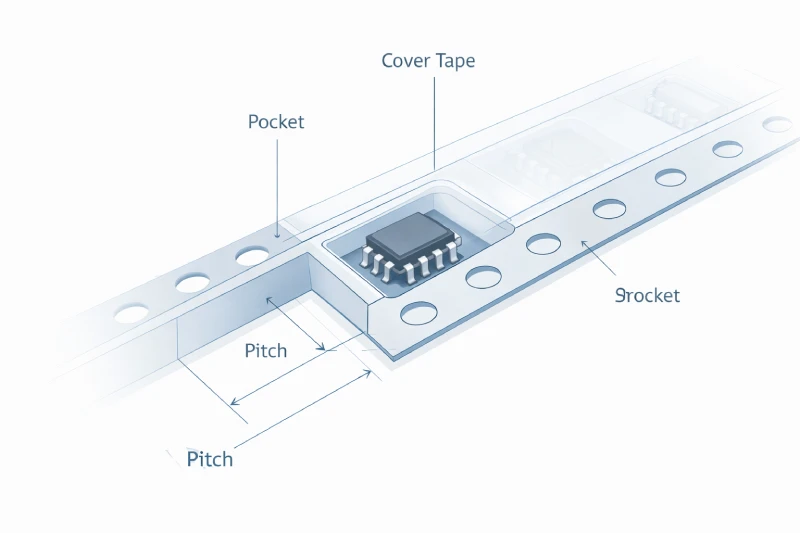
1. Pocket Dimensions
Each pocket must match the component:
- Width (W)
- Depth (D)
- Length (L)
Too tight → component damage
Too loose → misalignment or flipping
2. Tolerance Control (Critical for SMT Feeding)
Precision is everything in automated assembly.
| Parameter | Typical Tolerance |
|---|---|
| Pocket size | ±0.05 mm |
| Pitch | ±0.1 mm |
| Hole alignment | Strict EIA compliance |
Even small deviations can cause:
- Feeding jams
- Pick-up errors
- Placement defects
3. Cover Tape Compatibility
The interaction between carrier tape and cover tape must be optimized.
Key factor:
- Peel force range (typically 0.1–1.0 N)
Too strong → component lifting
Too weak → contamination or loss
👉 Learn more about optimizing peel performance with our cover tape compatibility guide.
4. Compliance with EIA-481 Standards
Formed carrier tape must follow EIA-481 specifications, including:
- Sprocket hole spacing
- Tape width
- Pocket pitch
This ensures compatibility with global SMT equipment.
Formed Carrier Tape vs Embossed Carrier Tape
Understanding the difference helps you choose the right solution.
| Feature | Formed Carrier Tape | Embossed Carrier Tape |
|---|---|---|
| Process | Thermoforming | Embossing |
| Precision | High | Medium |
| Cost | Higher | Lower |
| Customization | High | Limited |
| Applications | Precision components | Standard components |
👉 Rule of thumb:
- Use formed tape for high-value or complex components
- Use embossed tape for standard, high-volume parts
Common Applications of Formed Carrier Tape
Formed carrier tape is widely used across industries requiring precision packaging.
Typical Applications:
- Semiconductor components (ICs, chips)
- LED packaging
- Automotive electronics
- Connectors and sensors
Each application requires tailored pocket design to ensure secure transport and accurate placement.
Common Problems & How to Avoid Them
Even well-designed systems can fail without proper engineering control.
1. Pocket Deformation
Cause:
- Incorrect material selection
- Poor forming conditions
Solution:
- Use higher-strength materials (e.g., PET, PC)
- Optimize forming temperature
2. Feeding Issues in SMT
Cause:
- Pitch inconsistency
- Sprocket hole misalignment
Solution:
- Strict tolerance control
- EIA-481 compliance verification
3. Cover Tape Peeling Failure
Cause:
- Incorrect peel force
- Poor sealing conditions
Solution:
- Test peel strength before mass production
- Match carrier and cover tape materials
👉 These issues can significantly impact yield rates—working with an experienced supplier helps prevent them early.
Custom Formed Carrier Tape: What You Need to Provide
Custom solutions deliver the best performance—but require accurate input data.
Required Information:
- Component drawing (2D or 3D)
- Dimensions and tolerances
- Quantity requirements
- Tape width and reel specifications
- ESD requirements
Providing complete data ensures:
- Faster sampling
- Accurate mold design
- Reduced iteration cycles
👉 Send us your component drawing for a free design evaluation and sample development.
How to Choose a Reliable Formed Carrier Tape Supplier
Selecting the right supplier is critical for both performance and long-term scalability.
Key Evaluation Criteria:
1. Tooling Capability
- In-house mold development
- High-precision machining
2. Standards Compliance
- EIA-481 adherence
- Quality inspection systems
3. Engineering Support
- Design optimization suggestions
- Material recommendations
4. Production Flexibility
- Small MOQ support
- Fast sampling turnaround
5. SMT Validation
- Real feeding tests
- Peel force testing
👉 Partner with a supplier who understands both packaging and SMT processes—not just plastic forming.
FAQs
What is the difference between formed and embossed carrier tape?
Formed carrier tape uses thermoforming for higher precision, while embossed tape is more cost-effective but less accurate.
What material is best for high-temperature SMT processes?
Polycarbonate (PC) is typically preferred due to its high thermal resistance and dimensional stability.
How can I ensure pocket accuracy?
Work with a supplier that offers precision tooling, strict tolerance control, and sample validation before mass production.
Can I order custom formed carrier tape in small quantities?
Yes. Many manufacturers support small MOQ orders for prototyping and new product development.
Conclusion: Why Formed Carrier Tape Matters More Than You Think
Formed carrier tape is not just packaging—it is a precision-engineered component of your SMT process.
The right design and supplier can:
- Improve feeding reliability
- Reduce defects and downtime
- Enhance overall production efficiency
On the other hand, poor-quality tape can lead to costly production issues that far exceed the initial savings.