
Precision Carrier Tape Packaging Solutions from China

Pressure Sensitive Cover Tape for Controlled SMT Sealing

Pressure sensitive cover tape is designed for SMT tape-and-reel applications where controlled sealing behavior, stable peel force, and optical transparency are required.

The adhesive layer is activated under defined temperature and pressure, allowing the cover tape to seal reliably onto compatible carrier tape materials without thermal deformation of the carrier substrate.

This type of cover tape is typically selected when process stability, feeder consistency, and peel force repeatability are critical to automated pick-and-place performance.

    Suitable Applications

  • SMT tape-and-reel packaging requiring stable and repeatable peel force
  • Automated pick-and-place lines with controlled sealing temperature capability
  • Applications requiring transparent cover tape for visual component inspection
  • Packaging lines using PS, PET, or PVC embossed carrier tapes
  • Medium to high-speed SMT feeders where peel angle and force consistency are critical
  • Share:

Sealing Principle & Operational Characteristics

  • Sealing Principle

    Pressure sensitive cover tape seals through an adhesive layer activated by controlled heat and pressure.

    The sealing process relies on pressure-assisted adhesion rather than full thermal melting, ensuring reliable bonding without carrier tape deformation.

    Operational Characteristics

    Once sealed, the cover tape provides stable peel force at standard feeder peel angles, supporting consistent component release.

    The transparent film allows visual confirmation of component presence and orientation during SMT feeding.
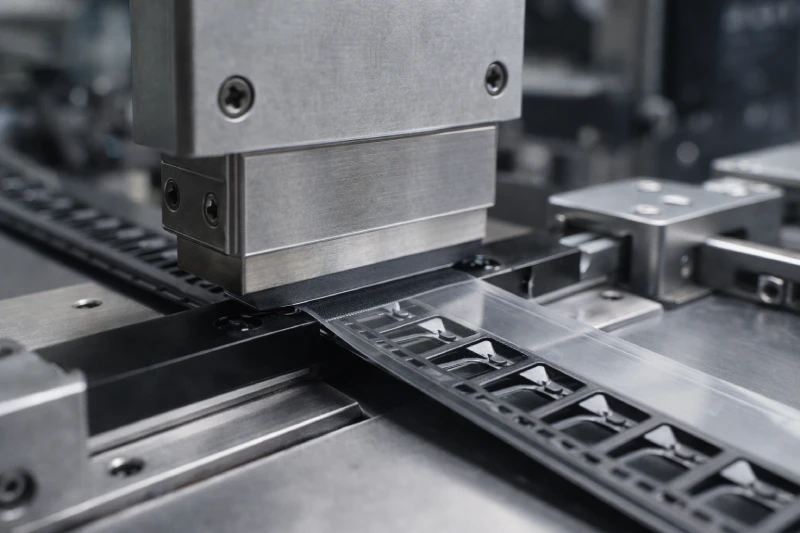

  • Pressure sensitive cover tape being sealed onto embossed carrier tape using controlled heat and pressure in an SMT tape-and-reel packaging process

Compatibility with Carrier Tape Materials

Compatibility depends on carrier tape material and sealing conditions. Proper matching results in stable sealing and controlled peel force.

Common compatible carrier tape materials

  • PS (Polystyrene): generally stable sealing response; verify peel force window to avoid over-adhesion

  • PET: typically requires tighter control of heat and pressure for repeatable sealing

  • PVC: can seal reliably, but process settings should avoid excessive heat input

Typical mismatch risks

  • Under-seal: edge lift or partial adhesion, leading to peeling instability in feeders

  • Over-seal: peel force too high, increasing pickup variation or component displacement

  • Adhesive transfer / residue: contamination on carrier tape edge or cover tape filmv

Recommended validation
Confirm sealing with the intended carrier tape by checking seal continuity, peel force stability, and no pocket deformation under production settings.

Anti-Static Configuration & Model Classification

Anti-static configuration options

  • Single-side anti-static: controls surface charge during peeling; suitable for standard ESD-sensitive components

  • Double-side anti-static: enhanced charge dissipation on both film surfaces; used for higher ESD control requirements

Model classification reference

  • JSRF series: pressure sensitive cover tape with heat-assisted sealing

    • JSRF-03D: single-side anti-static

    • JSRF-03S: double-side anti-static

  • JSLF series: heat-activated cover tape (reference category for process comparison)

Model differences primarily relate to anti-static structure, sealing behavior, thickness, and reel length, and should be confirmed during sampling.

Model Sealing Type Anti-Static Configuration Thickness Reel Length
JSRF-03D Pressure Sensitive (Heat-Assisted) Single-Side ≈ 0.03 mm 300 m / 500 m
JSRF-03S Pressure Sensitive (Heat-Assisted) Double-Side ≈ 0.03 mm 300 m / 500 m
JSLF Series Heat Activated Single / Double-Side Model Dependent Model Dependent

Width Matching & Dimensional Selection Rules

  • Width selection rules

    • Cover tape width is defined by the nominal carrier tape width

    • Edge coverage must remain uniform to prevent edge lift or feeder interference

    • Excessive overhang should be avoided to maintain consistent peel behavior

  • Dimensional validation

    • Verify sealing continuity along both tape edges

    • Confirm peel force stability at the intended feeder peel angle

    • Ensure no interference with sealing heads or feeder guides

Carrier Tape Width (mm) Recommended Cover Tape Width (mm)
8 5.3
12 9.3
16 13.3
24 21.3
32 25.5
44 37.5
56 49.5
72 65.5
88 81.5

Typical SMT Production Scenarios

Pressure sensitive cover tape is commonly used in SMT production environments where sealing stability and peel force consistency directly affect feeding performance.

  • High-Speed Pick-and-Place Lines

    Used in high-speed SMT lines where peel force consistency is required to maintain stable component release at fixed feeder peel angles.

  • Mixed Component Production

    Applied in production lines handling multiple component types, reducing sealing variability and minimizing feeder adjustment between product changeovers.

  • Visual Inspection During Feeding

    Selected where transparent cover tape allows visual confirmation of component presence and orientation before pick-up.

  • Controlled Sealing Operations

    Common in tape-and-reel processes equipped with heat-assisted pressure sealing, ensuring repeatable sealing under defined process parameters.

Sampling & Lead Time Expectations

Sampling and lead time depend on tape width, anti-static configuration, and order quantity. The following timelines represent typical expectations under standard production conditions.

  • Sampling

    • Sampling lead time: 1–2 days (depending on quantity and configuration)

    • Sample reels are used to verify sealing behavior, peel force stability, and carrier tape compatibility

    • Final specifications should be confirmed based on actual SMT line conditions

  • Production

    • Standard production lead time: 3–10 days (depending on order volume)

    • Lead time varies with width range, ESD structure, and reel length requirements

    • Production scheduling is finalized after sample approval

Relationship to Carrier Tape & Other Cover Tape Types

Pressure sensitive cover tape functions as part of a matched tape-and-reel system, where sealing behavior, peel force, and dimensional compatibility must align with the selected carrier tape.

Its selection is typically made after carrier tape material and pocket design are defined, and before final sealing parameters are confirmed on the SMT line.

  • Relationship to carrier tape

    • Seals onto embossed carrier tape to retain components during transport and feeding

    • Requires material and width compatibility to maintain stable edge sealing and peel behavior

    • Performance is evaluated together with the carrier tape, not independently

Request A Quote

Header Form