
Introduction
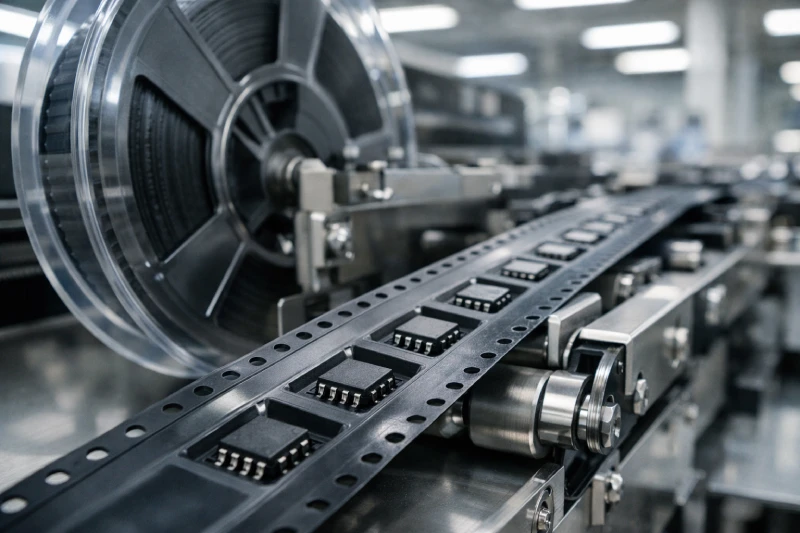
In modern electronics manufacturing, even a tiny electrostatic discharge (ESD) can destroy sensitive components before they ever reach the PCB. This is especially critical in semiconductor packaging, where ICs and micro-components are highly vulnerable to static electricity during handling and transport.
This is where conductive carrier tape plays a crucial role.
Unlike standard packaging materials, conductive carrier tape is specifically engineered to dissipate electrical charges instantly, ensuring that components remain protected throughout automated SMT (Surface Mount Technology) processes. From IC chips to precision connectors, it is widely used in applications where ESD risk must be minimized to near zero.
In this guide, we’ll break down how conductive carrier tape works, how it differs from antistatic solutions, and how to choose the right specification for your application.
What Is Conductive Carrier Tape?
Conductive carrier tape is a type of embossed or formed plastic tape used in tape-and-reel packaging that has electrically conductive properties to safely discharge static electricity.
Key characteristics include:
- Surface resistance: Typically between 10³–10⁵ Ω/sq
- Material structure: Conductive additives or coatings embedded in plastic (PS, PET, or PC)
- Function: Rapid dissipation of electrostatic charges
- Application: High-sensitivity electronic components
Unlike standard carrier tape, conductive versions are designed to actively move electrical charge away from the component, reducing the risk of latent or catastrophic ESD damage.
This makes them essential in industries such as semiconductor manufacturing, automotive electronics, and high-reliability devices.
How Conductive Carrier Tape Works
Understanding the working mechanism of conductive carrier tape helps explain why it is critical in ESD-sensitive environments.
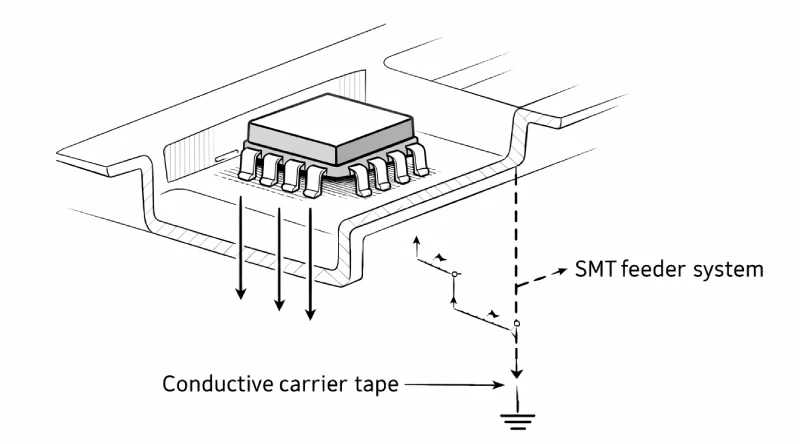
The process can be broken down into four steps:
1. Component Placement
Electronic components are placed into precisely formed pockets within the carrier tape.
2. Contact with Conductive Material
The pocket surface contains conductive material (typically carbon-loaded plastic), which comes into contact with the component.
3. Charge Dissipation
Any electrostatic charge present on the component is immediately transferred to the conductive tape surface.
4. Grounding Path
The charge flows through the tape, reel, and SMT feeder system, eventually reaching ground.
This controlled dissipation path ensures that static charges do not accumulate, which is a common cause of ESD-related failures during high-speed automated assembly.
Conductive vs Antistatic Carrier Tape: Key Differences
One of the most common mistakes in electronics packaging is confusing conductive and antistatic carrier tapes. While both are related to ESD control, they serve fundamentally different purposes.
| Feature | Conductive Carrier Tape | Antistatic Carrier Tape |
|---|---|---|
| Surface Resistance | 10³–10⁵ Ω/sq | 10⁶–10¹¹ Ω/sq |
| Charge Behavior | Actively dissipates charge | Prevents charge buildup |
| Protection Level | Maximum (ESD-safe) | Moderate |
| Typical Use | ICs, semiconductors | General electronics |
| Cost | Higher | Lower |
Key insight:
- Conductive tape = removes charge immediately
- Antistatic tape = reduces the chance of charge forming
For high-value or highly sensitive components (such as IC chips), conductive carrier tape is often mandatory, not optional.
If you’re evaluating standard ESD protection solutions, you may also want to review our detailed guide on antistatic carrier tape.
Materials Used in Conductive Carrier Tape
The performance of conductive carrier tape depends heavily on the base material and how conductivity is achieved.
Common Base Materials
Polystyrene (PS)
- Cost-effective
- Suitable for general electronic components
- Moderate dimensional stability
Polyethylene Terephthalate (PET)
- Higher precision and strength
- Better thermal stability
- Suitable for automated SMT lines
Polycarbonate (PC)
- High-end material for semiconductor applications
- Excellent dimensional accuracy
- Superior mechanical strength
Conductivity Methods
- Carbon-loaded materials: Conductive particles mixed into the plastic
- Surface coating: Conductive layer applied to the tape surface
Each method affects performance, durability, and cost. For example, carbon-loaded materials offer long-term stability, while coatings may be more cost-efficient but less durable.
Key Specifications You Must Check
Selecting the right conductive carrier tape requires careful evaluation of technical parameters. Ignoring these can lead to feeding issues, component damage, or production downtime.
| Parameter | Why It Matters |
|---|---|
| Surface Resistance | Determines ESD protection level |
| Pocket Dimensions | Ensures proper component fit |
| Pitch | Affects feeding accuracy |
| Tape Thickness | Impacts strength and flexibility |
| Peel Force | Ensures compatibility with cover tape |
Pro Tip:
Even small deviations in pocket size or pitch can cause misfeeds in high-speed SMT lines, especially when running at scale.
Applications of Conductive Carrier Tape
Conductive carrier tape is widely used across industries where ESD protection is critical.
Typical applications include:
- Semiconductor IC packaging
- LED chips and optoelectronics
- Automotive electronics (ECUs, sensors)
- Precision connectors
- MEMS devices and micro-components
In these applications, even minor electrostatic discharge can result in hidden defects, leading to field failures or reduced product lifespan.
Common Problems and How to Avoid Them
Even with conductive carrier tape, improper selection or usage can cause issues. Below are common problems and their solutions:
| Problem | Cause | Solution |
|---|---|---|
| ESD damage | Using antistatic instead of conductive | Upgrade to conductive tape |
| Feeding issues | Incorrect pitch or dimensions | Follow EIA-481 standards |
| Component movement | Poor pocket design | Optimize cavity structure |
| Cover tape failure | Incorrect peel force | Match cover tape specifications |
How to Choose the Right Conductive Carrier Tape Supplier
Choosing the right supplier is just as important as choosing the right material.
Here’s a practical checklist:
- EIA-481 compliance
- Custom tooling capability
- Material traceability
- Stable conductive performance
- Low defect rate in mass production
- Flexible MOQ for prototyping
- Fast lead time
A reliable supplier should also be able to provide engineering support, including pocket design optimization and sampling before mass production.
Cost Factors of Conductive Carrier Tape
The cost of conductive carrier tape depends on several factors:
- Material type: PC > PET > PS
- Tooling cost: Custom molds increase upfront investment
- Order volume: Larger quantities reduce unit cost
- Precision requirements: Tighter tolerances increase cost
While conductive tape is more expensive than antistatic alternatives, the cost of ESD failure is significantly higher, especially in high-value electronics.
FAQs
1. What is the difference between conductive and antistatic carrier tape?
Conductive tape dissipates charge instantly, while antistatic tape only prevents charge buildup.
2. When should I use conductive carrier tape?
When handling highly sensitive components such as ICs, semiconductors, or precision electronics.
3. What is the surface resistance of conductive tape?
Typically between 10³ and 10⁵ ohms per square.
4. Can conductive tape eliminate ESD completely?
It significantly reduces ESD risk but should be used as part of a complete ESD control system.
5. Is conductive carrier tape required for IC packaging?
In most semiconductor applications, yes—it is considered essential.
Conclusion
Conductive carrier tape is not just a packaging material—it is a critical component in ESD control strategy for modern electronics manufacturing.
By actively dissipating electrostatic charges, it protects sensitive components from hidden damage, improves production reliability, and reduces costly failures in the field.
Choosing the right material, specification, and supplier can make a significant difference in both performance and long-term cost efficiency.
Need help selecting or customizing conductive carrier tape?
Contact our engineering team today to get a tailored solution based on your component specifications and SMT requirements.