

Introduction
In modern electronics manufacturing, efficiency and reliability are critical—especially in high-speed SMT (Surface Mount Technology) assembly. One essential yet often overlooked component of this process is tape and reel packaging, specifically the combination of conductive carrier tape and cover tape.
These materials work together to protect sensitive electronic components from electrostatic discharge (ESD), mechanical damage, and feeding errors during automated assembly. For engineers, procurement teams, and OEM buyers, selecting the right tape solution is not just about packaging—it directly impacts yield rate, production efficiency, and product quality.
In this guide, we’ll break down how conductive carrier tape and cover tape function as a system, what specifications matter most, and how to choose the right solution for your SMT application.
What Is Conductive Carrier Tape?
Conductive carrier tape is a specialized packaging material used to hold and transport electronic components in tape and reel systems. Unlike standard plastic tapes, conductive carrier tapes are designed to dissipate static electricity, protecting sensitive components such as ICs, LEDs, and semiconductors.
These tapes are typically made from materials such as polystyrene (PS), polyethylene terephthalate (PET), or polycarbonate (PC), with added conductive fillers like carbon black to achieve the desired electrical properties.
Key Features:
- Surface resistance: Typically between 10³–10⁶ ohms
- Pocket structure: Embossed cavities designed to match component geometry
- Material flexibility: PS for general use, PET/PC for precision and durability
- Compliance: Designed according to EIA-481 standards
The pocket design ensures that components remain stable during transport and feeding, while the conductive material prevents static buildup.
What Is Conductive Cover Tape?
Conductive cover tape is the sealing film applied over the carrier tape to secure components inside the pockets. While carrier tape provides structural support, cover tape ensures that components do not fall out, shift, or become contaminated.
There are two main types of cover tape:
1. Heat-Activated Cover Tape
- Requires heat during sealing
- Offers strong and consistent adhesion
- Suitable for high-reliability applications
2. Pressure-Sensitive Cover Tape (PSA)
- No heat required
- Easier to use in flexible production setups
- Faster setup but may vary in peel consistency
Key Considerations:
- Peel strength control (critical for SMT feeders)
- ESD-safe or conductive properties
- Compatibility with carrier tape material
A poorly matched cover tape can lead to peeling issues, component loss, or machine downtime.
How Carrier Tape and Cover Tape Work Together
Carrier tape and cover tape function as a complete packaging system, not as independent components.
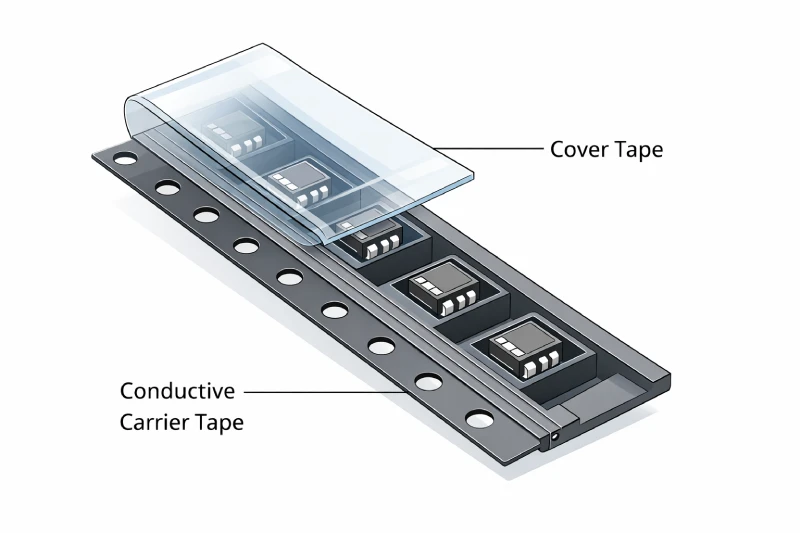
Typical Workflow:
- Components are placed into carrier tape pockets
- Cover tape is applied to seal the pockets
- The tape is wound onto reels
- Reels are loaded into SMT feeders
- Cover tape is peeled during feeding, exposing components for pick-and-place
This synchronized process ensures both mechanical stability and ESD protection throughout the supply chain.
Why Matching Matters
If the carrier tape and cover tape are not properly matched:
- Peel force may be too high → feeder jams
- Peel force may be too low → components fall out
- Static protection may be compromised
- Feeding alignment may fail
For optimal performance, both tapes must be tested as a matched pair, especially in high-speed SMT environments.
Why Conductivity Matters in SMT Packaging
Electrostatic discharge (ESD) is one of the most significant risks in electronic component handling. Even small static charges can damage sensitive semiconductor devices.
Comparison of Material Types
| Type | Surface Resistance | Application |
|---|---|---|
| Conductive | 10³–10⁶ Ω | High-sensitivity ICs |
| Antistatic | 10⁶–10¹¹ Ω | General SMT use |
| Insulative | >10¹² Ω | Non-electronic items |
Key Insights:
- Conductive materials actively dissipate charge
- Antistatic materials reduce charge buildup but do not dissipate as effectively
- Insulative materials should be avoided for electronic components
In high-reliability industries such as automotive or semiconductor manufacturing, conductive carrier tape is often the preferred choice.
Key Specifications to Consider
Choosing the right conductive carrier tape and cover tape requires careful evaluation of multiple technical parameters.
1. Pocket Dimensions & Tolerance
- Must match component size precisely
- Governed by EIA-481 standards
- Poor tolerance leads to misalignment or flipping
2. Tape Width & Pitch
- Common widths: 8mm, 12mm, 16mm, etc.
- Pitch affects feeding accuracy
3. Peel Strength
- Ideal range: 0.1–1.0 N (depending on application)
- Must be stable across temperature and humidity
4. Material Selection
- PS: Cost-effective, widely used
- PET: Better dimensional stability
- PC: High precision and strength
5. ESD Performance
- Ensure consistent conductivity across production batches
- Verify through ESD testing
Buyer Checklist
- Is the design EIA-481 compliant?
- Has peel force been tested under real SMT conditions?
- Are carrier and cover tape validated together?
- Is the material suitable for your component sensitivity?
- Does the supplier offer custom tooling?
Common Problems and How to Avoid Them
Even with high-quality materials, improper selection or mismatching can cause serious production issues.
1. Peeling Failure
- Cause: Incorrect peel strength
- Solution: Validate cover tape compatibility
2. Component Jumping or Flipping
- Cause: Poor pocket design
- Solution: Optimize cavity dimensions
3. Static Damage
- Cause: Incorrect material selection
- Solution: Use conductive materials for sensitive components
4. Feeding Jams
- Cause: Tolerance mismatch
- Solution: Ensure precision manufacturing
Applications of Conductive Carrier Tape and Cover Tape
These packaging systems are widely used across multiple industries:
- Semiconductor IC packaging
- LED packaging and transport
- Automotive electronics (high reliability requirement)
- Passive components (resistors, capacitors)
As components become smaller and more sensitive, the demand for high-quality conductive packaging continues to grow.
How to Choose the Right Supplier
Selecting a reliable supplier is just as important as choosing the right material.
Key Criteria:
- EIA-481 compliance
- Custom design capability
- Fast tooling and sampling
- Strict quality control (peel test, ESD test)
- Experience in your industry
⚠️ Red Flags:
- No peel strength data
- No ESD certification
- Limited customization options
- Inconsistent product quality
👉 Learn more: How to Choose a Carrier Tape Manufacturer
Custom vs Standard Carrier Tape Solutions
| Type | Advantages | Limitations |
|---|---|---|
| Standard | Lower cost, faster delivery | Limited compatibility |
| Custom | Perfect fit, higher reliability | Higher tooling cost |
For high-volume or high-precision applications, custom solutions often deliver better long-term value.
FAQs
1. What is the difference between conductive and antistatic carrier tape?
Conductive tape dissipates static electricity, while antistatic tape only reduces buildup.
2. What is peel strength in cover tape?
It is the force required to remove the cover tape during SMT feeding.
3. Can carrier tape be reused?
Generally no, due to deformation and contamination risks.
4. How do you test ESD performance?
By measuring surface resistance and charge decay.
5. What standard governs carrier tape?
EIA-481 is the primary industry standard.
Conclusion
Conductive carrier tape and cover tape are not just packaging materials—they are critical components of the SMT process. From ESD protection to feeding reliability, the right combination can significantly improve production efficiency and reduce defects.
For engineers and sourcing teams, the key is to focus on system compatibility, precise specifications, and supplier reliability.
👉 Looking for high-quality conductive carrier tape and cover tape solutions?
Our engineering team offers custom design, fast sampling, and full EIA-481 compliance to support your SMT production needs.
Contact us today to get a tailored solution for your components.