
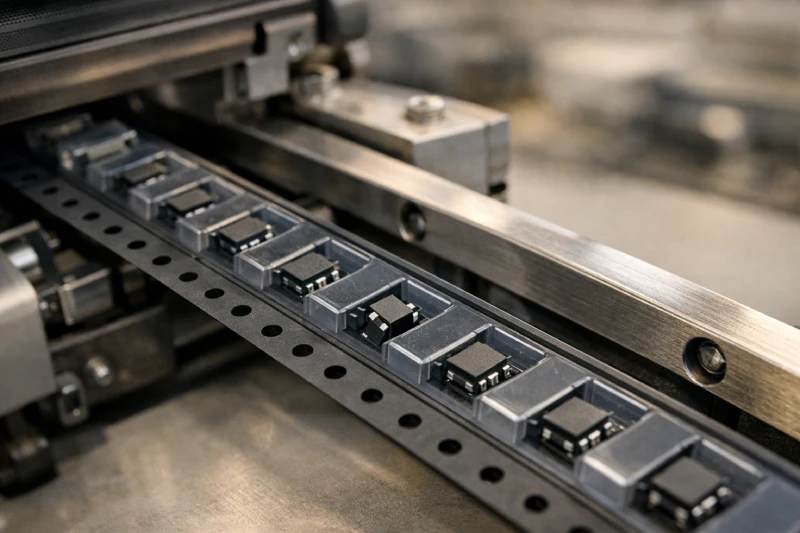
In high-speed SMT production, yield instability is often blamed on feeders, placement heads, or even component suppliers. Yet in many cases, the root cause lies earlier in the packaging chain. Carrier tape decisions made during component packaging directly influence feeding stability, pick accuracy, and long-term reliability.
The issue is rarely dramatic. Instead, it appears as subtle mis-picks, minor rotations, inconsistent peel behavior, or unexplained ESD failures. Engineers adjust feeder parameters, operators reduce line speed, and procurement looks for alternative suppliers—while the underlying packaging logic remains unexamined.
Most carrier tape problems are not manufacturing defects. They are decision mistakes: incorrect assumptions about standardization, pocket clearance, material behavior, or tolerance accumulation. Understanding these common misconceptions allows engineering teams to prevent recurring issues instead of repeatedly reacting to them.
Below are the most frequent carrier tape misunderstandings—and how to avoid them.
Is Standard Carrier Tape Always “Good Enough” for SMT Production?
Standard tape specifications work well for stable, mature components produced at moderate speeds. However, problems arise when production conditions evolve but packaging logic does not.
High-speed lines, ultra-small components, or irregular geometries create dynamic forces that standard structures may not accommodate. What appears dimensionally acceptable on paper may become unstable under acceleration, vibration, or peel stress.
The mistake is assuming that “industry standard” automatically equals “production-ready.” Standard formats are designed for compatibility, not optimization.
If feeding issues appear consistently at higher line speeds or with new component geometries, the question should shift from “Is the feeder tuned correctly?” to “Is the tape geometry optimized for this application?”
In such cases, evaluating whether a custom structural adjustment is required often eliminates long-term instability more effectively than repeated mechanical adjustments.
Are Pocket Dimensions the Only Thing That Matters?
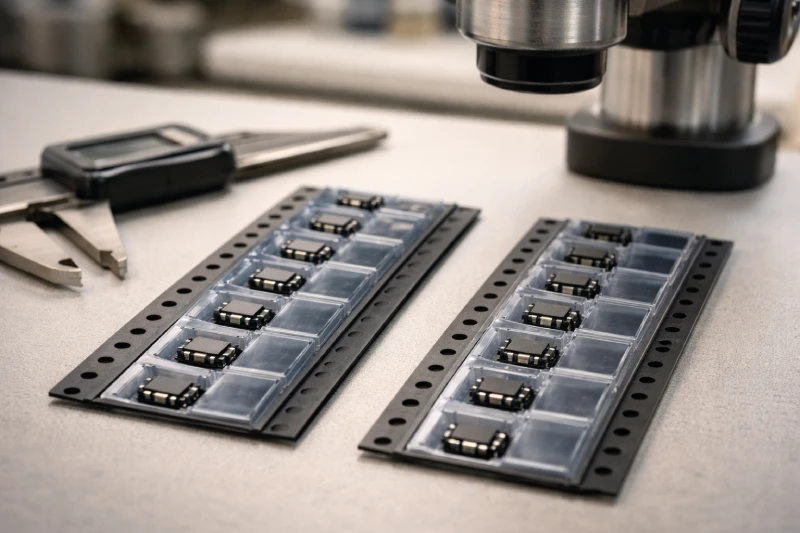
Many engineers focus almost exclusively on pocket length, width, and depth. While dimensional matching is critical, it is only one variable in a dynamic system.
Clearance behavior under motion differs from static measurement. A pocket that fits perfectly when measured may allow micro-movement during feeder acceleration. Conversely, overly tight pockets can increase friction and disrupt peel stability.
Component orientation inside the cavity is equally important. Pocket wall angle, bottom flatness, and corner radius influence how the component settles and how it reacts to vibration.
Another overlooked factor is the interaction between pocket geometry and cover tape peel force. Excessive upward tension during peeling can induce slight vertical lift, increasing the likelihood of rotation or tilt before pick-up.
Dimensions alone do not guarantee stability. Dynamic interaction between component mass, cavity shape, and peel mechanics determines real-world performance.
Can Incorrect Material Selection Cause Feeding or ESD Problems?
Material choice is often treated as secondary to geometry, yet it directly affects rigidity, static behavior, and environmental stability.
Different materials respond differently to humidity, temperature, and mechanical stress. Some provide higher stiffness but lower impact resistance. Others offer improved transparency or ESD performance but reduced structural rigidity.
In high-speed SMT environments, insufficient rigidity can amplify vibration effects, while overly rigid materials may increase stress concentration during winding and unwinding.
Electrostatic control introduces additional complexity. In dry production environments, insufficient static dissipation can increase component attraction or retention issues. However, selecting conductive properties beyond what the environment requires can be unnecessary and cost-inefficient.
Material decisions should align with environmental conditions, line speed, and component sensitivity—not simply follow legacy specifications.
Why Does Component Rotation Still Happen Even When Dimensions Look Correct?
Rotation issues frequently frustrate engineers because measured dimensions appear correct. The misunderstanding lies in assuming static fit equals dynamic stability.
During feeding, the tape advances incrementally. Acceleration and deceleration introduce micro-forces inside the pocket. If lateral clearance distribution is uneven, even slightly, repeated motion can gradually shift orientation.
Peel angle and peel force further contribute. As the cover tape separates, upward or diagonal force vectors may act on asymmetrical components. If pocket support is insufficient near edges or corners, small rotational displacement can occur.
Vibration transmitted from feeder rails also plays a role. Cumulative micro-movements are often invisible during manual inspection but become evident in high-volume automated production.
Solving rotation problems requires analyzing dynamic interaction—not merely rechecking pocket size.
Is Thicker Carrier Tape Always More Stable?
A common belief is that increasing material thickness improves stability. While greater thickness can increase rigidity, it also alters feeding behavior.
Thicker tape increases bending resistance during winding and unwinding. This may elevate tension forces inside the feeder path. In some cases, higher rigidity increases friction or causes micro-jumping during index movement.
Additionally, excessive stiffness can reduce compliance when the tape interacts with mechanical guides, leading to alignment inconsistencies.
Stability is not determined solely by thickness but by balanced rigidity relative to component mass, line speed, and feeder mechanics. Optimized structural behavior often results from proportion, not maximum material strength.
Are You Ignoring Sprocket Hole Accuracy and Pitch Tolerance?
When feeding problems appear, attention typically focuses on pocket geometry. However, cumulative pitch tolerance and sprocket hole alignment can be equally critical.
If hole spacing deviates slightly, indexing accuracy decreases progressively across long tape lengths. Even minimal cumulative error can disrupt synchronization between feeder motion and pick position.
Misalignment between pocket center and hole center also affects pick consistency. Over time, this results in minor placement deviation, especially in high-precision applications.
Engineers sometimes overlook that feeding stability depends on the entire mechanical reference system, not only cavity structure.
Evaluating hole punching precision and pitch consistency often reveals hidden sources of instability that are otherwise misattributed to feeder calibration.
When Should You Redesign the Carrier Tape Instead of Adjusting the Feeder?
Adjusting feeder parameters is often the first reaction to instability. In many cases, this resolves minor mismatches. However, repeated adjustments without long-term stability indicate a structural mismatch rather than a mechanical tuning issue.
If problems persist across multiple machines, shifts, or production batches, the packaging design itself may require review.
Redesign becomes necessary when:
- Rotation persists despite parameter optimization
- Peel instability affects multiple reels
- Tolerance-related misalignment appears consistently
- Speed reduction is the only temporary solution
At this stage, redesigning cavity geometry, clearance distribution, or material structure is typically more efficient than continuous operational compensation.
Engineering stability should be designed into the packaging system—not forced through mechanical adjustment.
Final Perspective
Carrier tape mistakes are rarely obvious. They emerge gradually through micro-instability, yield variation, or operational inefficiency. The key is recognizing when the issue is structural rather than procedural.
By re-evaluating assumptions about standardization, geometry, material behavior, and tolerance control, engineering teams can prevent recurring production disruptions.
Stable SMT feeding is not achieved by reacting to problems—it is achieved by aligning packaging design with dynamic production reality.