
Introduction
Moisture is often treated as a storage or logistics concern, but in electronic packaging, it directly influences dimensional stability and feeding reliability. In high-speed SMT environments, even small structural changes in carrier tape can translate into misalignment, unstable indexing, or increased component rotation inside pockets. These issues rarely appear during incoming inspection; they typically surface on the production line, where tension, acceleration, and mechanical stress amplify small material variations.
For packaging engineers and SMT process teams, understanding carrier tape moisture resistance is not about preventing cosmetic defects. It is about maintaining pocket geometry, sprocket hole accuracy, and consistent component retention under real production conditions. This article explains what happens when carrier tape absorbs moisture, how it affects feeding performance, how different materials respond to humidity, and how to evaluate moisture resistance before mass production. The goal is to support better engineering decisions at the design and sourcing stage.
What Happens When Carrier Tape Absorbs Moisture?
Most thermoplastic materials used in embossed carrier tape exhibit some degree of moisture absorption. Even when the absorption rate is relatively low, the effect on dimensional stability can be measurable. Moisture uptake can lead to slight expansion, softening, or reduction in stiffness. While these changes may seem minimal in isolation, they become significant when tight tolerances are required for automated feeding.
One of the first areas affected is pocket structure. As the material absorbs moisture, its rigidity may decrease, reducing sidewall support. This can alter pocket dimensions or change how firmly components are held. Additionally, small variations in tape width or sprocket hole pitch can influence indexing accuracy in SMT feeders.
In environments with fluctuating humidity—such as coastal regions or long-duration sea freight—carrier tape may experience repeated cycles of absorption and drying. Over time, this can introduce cumulative dimensional instability. For engineers responsible for yield consistency, moisture absorption is therefore not just a material property; it is a process reliability variable.
Does Moisture Affect Pocket Geometry and Component Stability?
Pocket geometry is central to component stability during transport and feeding. When moisture alters material stiffness, pocket walls may lose some of their structural integrity. Even slight softening can increase lateral clearance between the component and the pocket, particularly for small or thin packages.
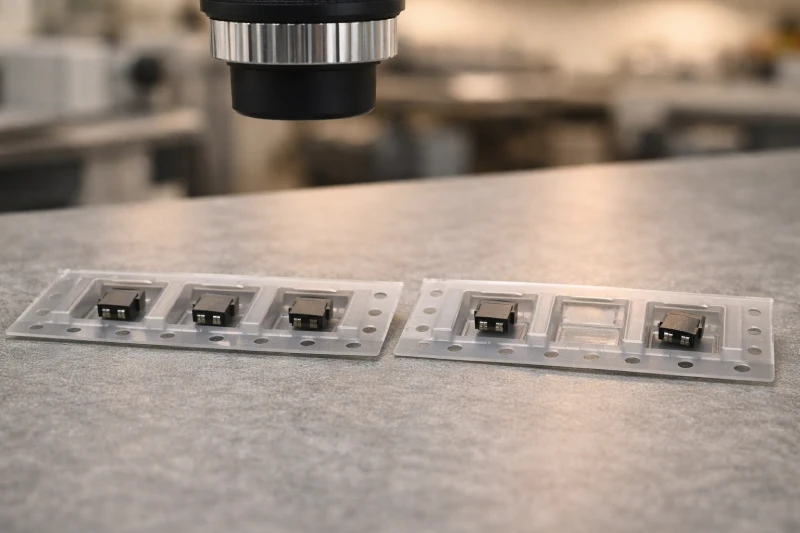
In high-speed SMT lines, dynamic forces act on the tape as it advances through the feeder. Acceleration, vibration, and indexing tension amplify any looseness inside the pocket. If retention force decreases due to humidity-induced softening, the risk of component rotation or tilt increases. For fine-pitch or orientation-sensitive components, even minor positional shifts can affect pick-up accuracy.
Moisture-related deformation may not always be visible during static inspection. However, once the tape is under continuous motion, weakened pocket support can result in inconsistent presentation at the pick-up point. For custom pocket designs, especially those optimized for minimal clearance, evaluating behavior under elevated humidity becomes particularly important to ensure long-term feeding stability.
Which Carrier Tape Materials Offer Better Moisture Resistance?
Different carrier tape materials exhibit different moisture absorption characteristics. Common materials such as PS, PET, and PC each present trade-offs in rigidity, dimensional stability, and environmental resistance.
PS is widely used for its processability and cost efficiency. While its moisture absorption is generally moderate, changes in stiffness under high humidity may need evaluation in demanding applications. PET typically provides better dimensional stability and mechanical strength, making it suitable for environments where humidity variation is expected. PC can offer higher impact resistance and structural strength but may require careful material formulation to balance cost and performance.
Conductive or anti-static formulations introduce additional considerations. The additives used to achieve ESD performance can influence moisture interaction, depending on the compound design. For applications involving long shipping cycles, high-humidity regions, or sensitive components, selecting a material with stable mechanical properties under humidity exposure becomes part of the risk mitigation strategy. Material choice should therefore align with environmental conditions and SMT process speed, not only with basic dimensional requirements.
How Does Humidity Impact SMT Feeding Performance?
SMT feeding systems rely on precise interaction between sprocket holes, feeder gears, and controlled tape tension. When humidity affects tape dimensions or stiffness, indexing accuracy can be compromised. Even slight elongation or softening can alter how the tape engages with the feeder mechanism.
Reduced stiffness may also influence how the tape bends around feeder rails. Inconsistent bending resistance can change the angle at which pockets present components to the pick-up nozzle. At lower production speeds, these variations might remain within tolerance. However, at high-speed assembly, small inconsistencies can accumulate, leading to increased pick errors or intermittent misalignment.
Another factor is tension control. Moisture-induced flexibility can affect how the tape responds to pulling forces, especially during rapid acceleration and deceleration cycles. Over time, this may contribute to unstable feeding behavior that is difficult to trace back to humidity exposure. For process engineers analyzing yield fluctuations, environmental stability of the carrier tape should be considered alongside feeder calibration and machine parameters.
How to Evaluate Carrier Tape Moisture Resistance Before Mass Production?
Evaluating moisture resistance should be part of the qualification process, particularly for high-reliability or high-speed applications. A structured assessment can reduce the risk of unexpected feeding issues after large-scale deployment.
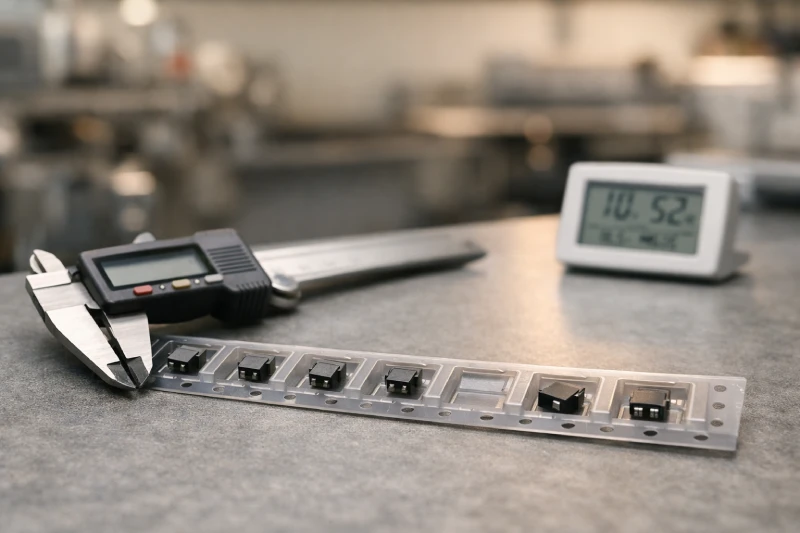
A typical evaluation approach includes controlled humidity exposure using a temperature and humidity chamber. After conditioning, key dimensions such as tape width, pocket depth, and sprocket hole pitch should be re-measured to identify any variation. Mechanical properties, including retention force, can also be tested to assess changes in component stability within the pocket.
In addition to static measurements, simulated feeding trials under elevated humidity conditions provide practical insight. Running the conditioned tape through a representative feeder at production speed helps reveal dynamic effects that may not appear in laboratory measurements alone.
For procurement and engineering teams, defining a pre-production checklist—covering environmental exposure, dimensional verification, and feeding validation—ensures that moisture resistance is verified before full-scale rollout.
When Should You Consider Moisture-Resistant or Customized Carrier Tape?
Not all applications require enhanced moisture resistance. However, certain scenarios increase the importance of humidity stability.
Long sea freight routes, extended warehouse storage, and deployment in tropical or coastal regions expose packaging materials to higher and more variable humidity levels. Similarly, high MSL components or precision devices with strict orientation requirements demand consistent pocket retention. High-speed SMT lines further amplify minor material variations.
In these contexts, evaluating moisture-resistant materials or customized pocket designs can improve long-term reliability. Custom solutions may include optimized wall thickness, tailored pocket geometry, or material selection aligned with environmental conditions. The decision should be based on risk analysis, considering shipping duration, storage conditions, and production speed, rather than solely on unit cost.
Conclusion
Moisture resistance in carrier tape is not merely a storage consideration; it is a structural and process reliability factor. Humidity can influence material stiffness, pocket geometry, sprocket hole accuracy, and ultimately feeding stability in SMT production. While the effects may be subtle, high-speed assembly and tight tolerances magnify small dimensional variations.
For packaging engineers and technical decision-makers, understanding how materials respond to humidity enables more informed sourcing and design choices. By incorporating moisture evaluation into the qualification stage—through environmental conditioning, dimensional measurement, and feeding validation—teams can reduce yield risk before mass production begins. In electronic packaging, long-term stability often depends on addressing environmental variables early in the design process.