
Industry Background
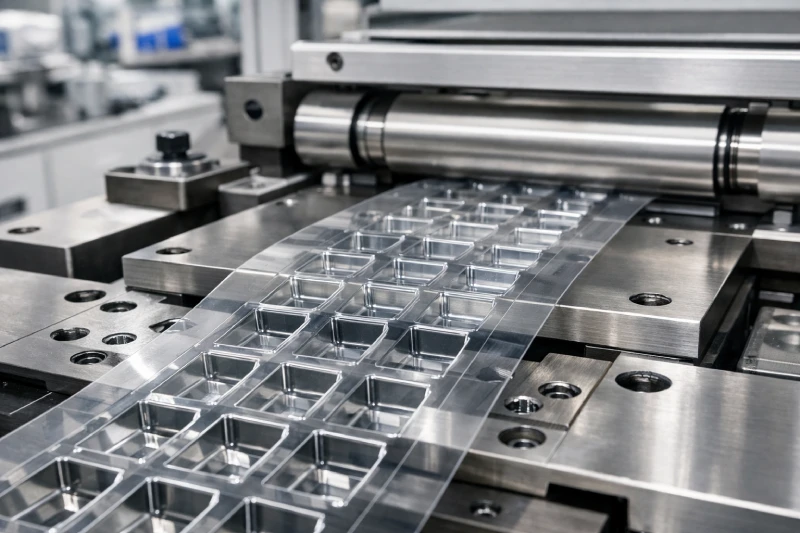
As electronic components continue to shrink while functional density increases, packaging tolerances have tightened accordingly. In SMT supply chains, embossed carrier tape is no longer treated as a passive transport medium. Pocket geometry, pitch accuracy, and material behavior directly affect pick-and-place stability, feeder compatibility, and downstream yield.
Over the past decade, component miniaturization, higher pin counts, and wider adoption of fine-pitch devices have pushed embossed carrier tape forming processes toward significantly higher precision requirements. This has driven incremental but meaningful advances in tooling design, forming control, and process validation rather than radical changes in materials or equipment categories.
Technical Challenge
The core challenge in embossed carrier tape manufacturing lies in achieving consistent pocket geometry at scale. Forming accuracy is influenced by multiple interdependent factors:
- Tooling dimensional stability under thermal and mechanical load
- Material flow behavior during forming
- Control of pitch and pocket alignment across long production runs
- Repeatability between cavities, reels, and production batches
As tolerances tighten, even minor variations in mold wear, temperature distribution, or forming pressure can translate into measurable pocket depth deviation or sidewall angle drift. These deviations may remain invisible at the tape level noticeable only during automated feeding, where misalignment leads to component tilt, mis-pick, or intermittent feeder stoppage.
Implications for Carrier Tape & Packaging
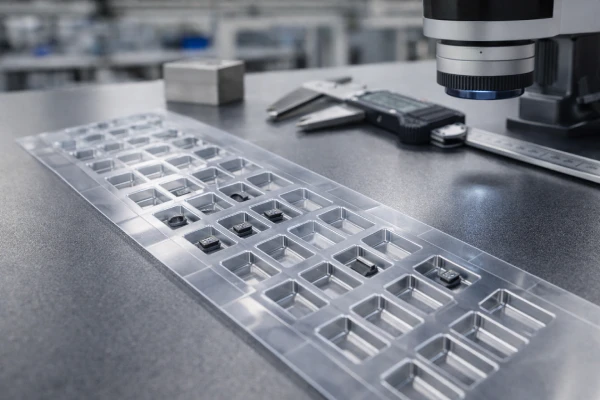
Higher forming accuracy requirements fundamentally change how embossed carrier tape is engineered and qualified. Standardized pocket designs that once tolerated wider dimensional windows now require tighter control to remain compatible with modern feeders and vision systems.
For embossed formats used in high-speed placement, inconsistencies in pocket depth or flatness can affect component seating stability, particularly for lightweight or asymmetric devices. In parallel, the rise of sensitive components has increased the need to balance forming precision with controlled material stress, especially for anti-static carrier tape constructions.
As a result, both standard embossed carrier tape and custom carrier tape increasingly rely on forming accuracy as a primary design constraint rather than a secondary quality attribute.
Engineering Considerations
From an engineering standpoint, improvements in forming accuracy are less about new materials and more about process discipline and tooling optimization:
- Tooling design: Multi-cavity molds must account for thermal expansion, uniform pressure distribution, and long-term wear. Micro-geometry transitions inside the pocket are increasingly optimized to reduce material thinning and elastic recovery.
- Forming control: Precise regulation of temperature, dwell time, and forming pressure is required to minimize variation between pockets and across reel length.
- Tolerance stack-up: Pocket depth, pitch, sprocket hole alignment, and cover tape interface must be evaluated as a system, not as isolated dimensions.
- Validation methods: Inline inspection and periodic gauge verification are increasingly used to monitor drift before it affects downstream assembly.
These considerations directly influence whether a carrier tape design can scale from sampling to stable mass production without redesign.
How Manufacturers Address This
Manufacturers addressing higher forming accuracy requirements typically focus on incremental process refinement rather than equipment replacement. Common approaches include:
- Upgrading forming tooling with tighter machining tolerances and improved surface finishes
- Implementing controlled mold maintenance cycles to reduce dimensional drift
- Using forming trials to characterize material behavior before finalizing pocket geometry
- Separating prototype tooling from mass-production tooling to avoid early wear bias
In custom projects, forming accuracy is often validated through feeder trials and component seating tests rather than relying solely on dimensional drawings. This reflects a shift toward functional validation as the primary acceptance criterion.
Related Packaging Solutions
Advances in forming accuracy intersect with several broader SMT packaging solutions:
- Embossed carrier tape systems designed for fine-pitch or miniature components
- Anti-static carrier tape configurations where material additives must not compromise form stability
- Custom carrier tape developments requiring non-standard pocket geometries or tight tolerance windows
- Integrated tape and cover tape combinations optimized for feeder performance
For readers evaluating carrier tape options, understanding forming accuracy as a process capability—not just a specification—can clarify why certain designs perform reliably at scale while others struggle during high-speed assembly.