
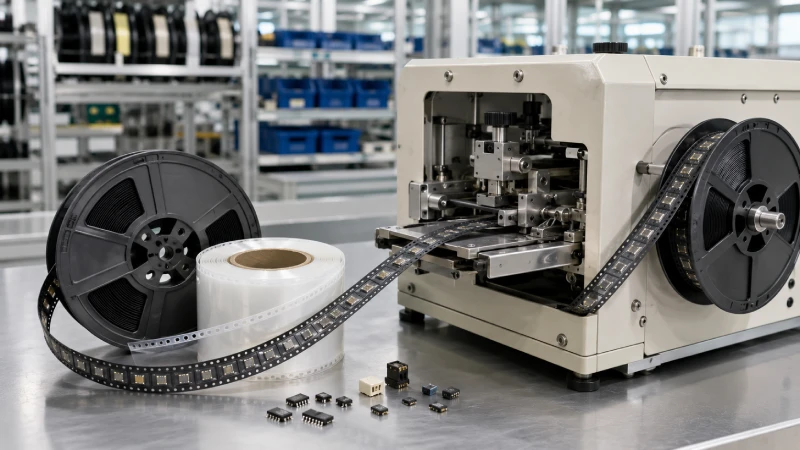
A stable tape-and-reel packaging process depends on more than choosing a suitable packaging machine. The carrier tape, cover tape, plastic reel, component pocket, winding direction, and downstream SMT feeder must work together as a complete packaging system.
A material combination may run through a packaging machine but still create problems during sealing, winding, shipping, or component feeding. Buyers should therefore confirm both equipment-related requirements and final application requirements before ordering packaging materials.
This guide explains the practical matching points buyers should review when selecting tape-and-reel packaging materials. It focuses on material compatibility and buyer-side confirmation rather than detailed equipment operation or machine settings.
Why Packaging Machines and Tape-and-Reel Materials Must Be Matched
Tape-and-reel packaging machines are designed to handle particular ranges of carrier tape widths, cover tape types, reel sizes, and packaging formats. However, machine compatibility alone does not guarantee that the finished package will work correctly.
The packaging materials must also suit the electronic component and the customer’s SMT production process.
For example, the carrier tape pocket must hold the component securely without damaging leads, terminals, or sensitive surfaces. The cover tape must seal consistently to the carrier tape and peel smoothly during feeding. The reel must provide enough capacity while fitting both the packaging machine and the customer’s feeder.
A mismatch in any of these areas can result in:
- Unstable cover tape sealing
- Components rotating or moving inside the pocket
- Carrier tape indexing problems
- Uneven or loose reel winding
- Incorrect component orientation
- Feeder interruptions
- Material waste and repacking
- Rejected packaging lots
Buyers should consider the complete process: component loading, sealing, winding, storage, transportation, cover tape peeling, and SMT feeder use.
The Main Parts of a Tape-and-Reel Packaging System
A typical SMT tape-and-reel packaging system includes four main elements.
Embossed Carrier Tape
The embossed carrier tape contains formed pockets that hold and protect individual components. Important selection points include tape width, pocket size, pocket depth, pocket pitch, sprocket-hole position, material type, and ESD performance.
Custom embossed carrier tape should be designed according to the actual component dimensions and shape rather than only a general package name.
Cover Tape
Cover tape seals components inside the carrier tape pockets. It must match the carrier tape material, sealing method, cover tape width, and required peeling performance.
Buyers may use heat-activated or pressure-sensitive cover tape depending on the packaging equipment, carrier tape surface, and production requirements.
Plastic Reel
The reel stores the sealed carrier tape and allows packaged components to be transported and loaded into an SMT feeder.
The selected plastic reel should match the carrier tape width, required packaging quantity, machine mounting system, winding direction, and feeder format.
Packaging Machine
The packaging machine loads components into the carrier tape, applies cover tape, seals the package, and winds the finished tape onto a reel.
From a buyer’s perspective, the most important information is not the machine’s complete engineering specification. Buyers mainly need to confirm which tape widths, sealing methods, reel sizes, and winding formats the machine supports.
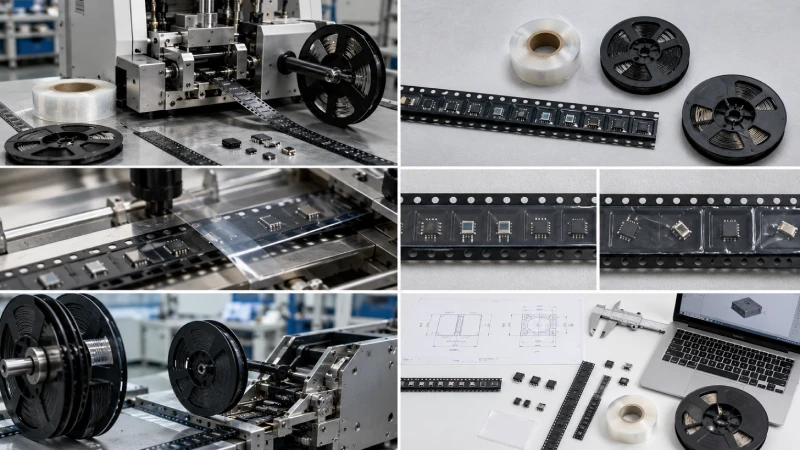
Machine-Related Material Factors Buyers Should Confirm
The following information helps a material supplier evaluate whether the selected carrier tape, cover tape, and reel are suitable for the intended packaging process.
| Machine-related material factor | Buyer confirmation point |
|---|---|
| Supported carrier tape width | Confirm whether the machine uses 8 mm, 12 mm, 16 mm, 24 mm, 32 mm, or another width |
| Cover tape sealing method | Confirm whether the equipment uses heat-activated or pressure-sensitive cover tape |
| Required cover tape width | Confirm the width and expected sealing position on the carrier tape |
| Reel diameter | Confirm whether the machine and feeder use a 7-inch, 13-inch, or another reel size |
| Reel width and hub | Confirm mounting, winding, storage, and feeder requirements |
| Winding direction | Confirm the sprocket-hole side, component direction, and winding orientation |
| Component loading direction | Provide a drawing or marked photo showing how the component should sit in the pocket |
| Feeder compatibility | Confirm the downstream feeder model or packaging standard |
| Sealing requirements | Identify concerns such as weak sealing, excessive peel force, or cover tape lifting |
| Inspection requirements | Confirm whether transparent materials or vision inspection are needed |
This information reduces the risk of ordering materials that fit the component but do not fit the machine, or materials that run on the machine but do not work correctly in the customer’s feeder.
Matching Carrier Tape with the Packaging Machine and Component
Carrier tape selection begins with the component, but the machine and feeder must also be considered.
Confirm the Carrier Tape Width
The carrier tape width must be large enough to accommodate the component pocket while remaining compatible with the packaging machine and feeder.
Common tape widths include 8 mm, 12 mm, 16 mm, 24 mm, and 32 mm, although wider formats are also available. Buyers should not choose a wider tape only because it provides more pocket space. The packaging equipment and downstream feeder must support that width.
Jiushuo provides different carrier tape solutions for electronic components with different sizes, shapes, protection requirements, and packaging formats.
Match the Pocket to the Component
The pocket is one of the most important parts of the packaging system. It should hold the component securely while allowing reliable loading and removal.
Buyers should provide the component’s:
- Length, width, and height
- Lead or terminal dimensions
- Overall shape
- Weight
- Fragile areas
- Sensitive surfaces
- Required orientation
A pocket that is too large may allow the component to rotate, tilt, or move during transportation. A pocket that is too tight may cause loading difficulty, component sticking, surface damage, or lead deformation.
Component drawings are useful, but physical samples are often recommended for custom pocket development, especially when the component has an irregular shape or delicate structure.
Confirm Pitch and Sprocket-Hole Alignment
Pocket pitch affects how the carrier tape moves through the packaging machine and feeder. Sprocket holes must also align correctly with the equipment’s indexing system.
The pitch should suit the component length and packaging format without creating unnecessary material consumption. The final selection should be confirmed together with the carrier tape width, pocket design, and feeder requirements.
Select the Appropriate Carrier Tape Material
Carrier tape materials may provide different levels of conductivity, antistatic performance, transparency, strength, and dimensional stability.
Conductive or antistatic carrier tape may be required for electrostatic-sensitive electronic components. Transparent tape may support visual inspection, while black conductive tape is commonly selected for ESD-sensitive applications.
The carrier tape material should not be selected independently. Its surface must also be suitable for the intended cover tape and sealing method.
Matching Cover Tape with Carrier Tape and Sealing Equipment
Cover tape compatibility involves more than choosing a width that fits the carrier tape.
Buyers should confirm:
- Carrier tape material
- Carrier tape surface
- Cover tape width
- Sealing method
- Required peel performance
- Storage environment
- Transportation conditions
- SMT feeder requirements
Heat-activated cover tape requires suitable sealing equipment and must bond consistently to the carrier tape sealing area. Pressure-sensitive cover tape uses an adhesive system and requires stable surface contact during application.
If the cover tape is too narrow, the sealing area may be insufficient. If it is too wide or positioned incorrectly, it may interfere with sprocket holes, pockets, or feeder peeling.
Sealing that appears acceptable immediately after packaging may still fail during winding, storage, or transportation. Conversely, an excessively strong seal may cause high or irregular peel force in the SMT feeder.
For this reason, cover tape performance should ideally be evaluated with the actual carrier tape, sealing method, and intended production conditions. Buyers should avoid assuming that one cover tape will work with every carrier tape material or packaging machine.
Matching Reel Size, Winding Direction, and Feeder Requirements
The reel is sometimes treated as a simple packaging accessory, but its dimensions and winding format directly affect production and final use.
Reel Diameter and Packaging Capacity
Smaller reels may be suitable for samples, development projects, short production runs, or lower quantities per reel. Larger reels can accommodate more carrier tape and may reduce reel changes in higher-volume production.
The reel diameter must be supported by both the packaging equipment and the customer’s storage or feeder system.
Reel Width and Hub Dimensions
The reel width should provide appropriate clearance for the loaded carrier tape. A reel that is too narrow may press against the tape edges, while excessive clearance may contribute to unstable winding.
Hub diameter and mounting dimensions should also be confirmed when the machine or feeder has a specific reel mounting structure.
Winding Direction and Component Orientation
Winding direction must be clearly communicated before production. Buyers should confirm:
- Sprocket-hole position
- Component top and bottom
- Component left and right orientation
- Leading direction
- Peel direction
- Clockwise or counterclockwise winding
- Required leader and trailer tape
A marked drawing, reference reel, or clear photo is often the easiest way to prevent misunderstandings.
SMT Feeder Compatibility
The finished package must work in the downstream feeder, not only on the packaging machine.
Feeder-related confirmation may include carrier tape width, pocket pitch, reel size, cover tape peel direction, sprocket-hole side, and component orientation.
A package can be sealed and wound successfully but still create feeding problems if final feeder requirements were not considered.
Common Matching Problems and Their Impact
Several recurring problems can be avoided through better buyer-side confirmation.
Carrier Tape Width Does Not Fit the Equipment
If the tape is outside the machine’s supported range, it may not enter the guide correctly or index consistently. This can lead to production stoppages, material replacement, or machine modification.
Cover Tape Width or Position Is Incorrect
Cover tape that is too narrow may produce an incomplete seal. Cover tape that is too wide or incorrectly aligned may interfere with sprocket holes or component pockets.
The result may be cover tape lifting, component loss, or unstable feeder peeling.
Carrier Tape and Cover Tape Do Not Seal Consistently
Poor material compatibility may cause weak seals, uneven bonding, excessive peel force, or cover tape separation during winding and shipping.
Sealing performance should be checked over the complete reel rather than only at the beginning of production.
The Pocket Does Not Match the Component
An oversized pocket can allow movement and rotation. An undersized pocket can cause component sticking, loading difficulty, surface damage, or lead deformation.
Poor pocket fit can also interfere with vision inspection and robotic pick-and-place operations.
Reel Size or Winding Direction Is Wrong
An unsuitable reel may not fit the machine or feeder. Incorrect winding direction may present components in the wrong orientation or require the reel to be rewound.
This creates additional handling, delays, and potential component damage.
Packaging Works on the Machine but Fails in the Feeder
This problem often occurs when only the packaging machine is considered. Irregular peel force, incorrect tape direction, component movement, reel dimensions, or pitch problems may appear only during SMT feeding.
Final confirmation should therefore include downstream-use requirements whenever possible.
What Buyers Should Send Before Ordering Packaging Materials
Providing complete information at the beginning can reduce repeated sampling and avoid preventable compatibility problems.
Component Information
Buyers should send:
- A dimensional component drawing
- A 3D file, when available
- Clear photos from multiple angles
- Physical samples for custom pocket development
- Component weight
- Lead, terminal, or fragile-area details
- Required loading orientation
Carrier Tape Requirements
Useful information includes:
- Required carrier tape width
- Pocket pitch, when already specified
- Conductive, antistatic, or standard material requirements
- Black or transparent tape preference
- Customer-specific or industry packaging requirements
Cover Tape Requirements
Buyers should confirm:
- Heat-activated or pressure-sensitive type
- Required cover tape width
- Expected peel performance
- Transparency requirements
- Current sealing or peeling problems, if replacing an existing material
Machine and Reel Information
Send the following when available:
- Packaging machine brand and model
- Supported tape widths
- Sealing method
- Reel diameter
- Reel width
- Hub size
- Winding direction
- Photos of the machine setup
- Photos or samples of current packaging materials
Downstream Application Information
Also provide:
- SMT feeder model
- Component orientation requirements
- Quantity per reel
- Leader and trailer requirements
- Storage and shipping conditions
- ESD protection requirements
A Practical Material Matching Process
A buyer-friendly matching process can be divided into five steps.
1. Confirm the Component
Review the component drawing, dimensions, samples, weight, orientation, and protection requirements.
2. Confirm the Carrier Tape
Select the tape width, pocket design, pitch, material, color, and ESD performance.
3. Confirm the Cover Tape
Match the cover tape type, width, sealing method, carrier tape surface, and expected peeling behavior.
4. Confirm the Reel and Winding Format
Confirm reel diameter, width, hub dimensions, capacity, sprocket-hole side, winding direction, leader, and trailer.
5. Test the Complete Combination
When possible, test the actual component, carrier tape, cover tape, reel, packaging machine, and SMT feeder together.
Machine descriptions and material datasheets are useful starting points, but final compatibility should be confirmed under the buyer’s actual production and application conditions.
How Jiushuo Supports Packaging Material Matching
Jiushuo supports buyers with complete SMT tape-and-reel packaging material combinations, including:
- Custom embossed carrier tape
- Conductive, antistatic, black, and transparent carrier tape options
- Heat-activated and pressure-sensitive cover tape
- Plastic reels in different diameters and widths
- Component pocket development
- Reel and winding-format confirmation
- Sample production and material evaluation
Jiushuo can review component drawings, physical samples, packaging machine information, sealing requirements, reel formats, and feeder requirements before sample development.
However, material compatibility should always be evaluated according to the specific component, machine, carrier tape, cover tape, reel, sealing process, and downstream feeder. No single material combination should be assumed to work with every packaging machine.
Request a Packaging Material Matching Review
Before ordering carrier tape, cover tape, or reels, send Jiushuo your component drawing or sample, packaging machine model, required tape width, sealing method, reel size, winding direction, and feeder requirements.
Jiushuo can help review the complete packaging material combination and recommend a suitable sampling plan for your application.
FAQ
Can one carrier tape be used on every tape-and-reel packaging machine?
No. Compatibility depends on carrier tape width, thickness, sprocket-hole alignment, pocket pitch, material behavior, and the formats supported by the packaging machine. Final feeder requirements must also be considered.
How do I know which cover tape is compatible with my carrier tape?
Confirm the carrier tape material, sealing surface, cover tape type, sealing method, cover tape width, and required peel performance. Testing the actual carrier tape and cover tape combination is recommended.
Should reel size be selected according to the packaging machine or the SMT feeder?
Both should be considered. The reel must fit the packaging machine during winding and also meet downstream storage, handling, and SMT feeder requirements.
What information is needed to confirm winding direction?
Provide the sprocket-hole side, component orientation, leading direction, cover tape peel direction, and required clockwise or counterclockwise winding. A marked drawing or reference reel can prevent misunderstandings.
Why can a package seal correctly but still cause feeder problems?
Possible causes include irregular peel force, incorrect winding direction, unsuitable reel dimensions, component movement, pocket pitch issues, or an incorrect sprocket-hole position.
Can Jiushuo match materials for an existing packaging machine?
Jiushuo can review the machine model, supported tape format, component information, sealing method, reel requirements, and feeder conditions. Final compatibility should be verified through samples or actual production testing.