
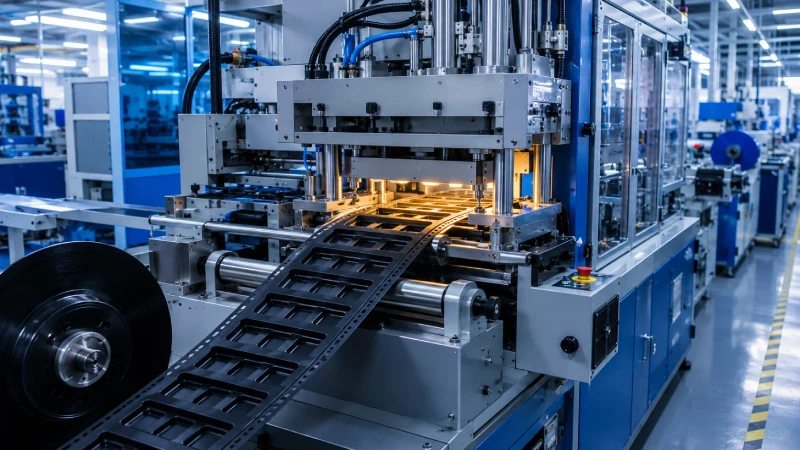
Modern SMT manufacturing depends heavily on precision packaging. As electronic components become smaller and production speeds continue to increase, manufacturers need reliable carrier tape systems that can protect components while ensuring stable automated feeding during assembly.
This is where a carrier tape forming machine becomes essential.
A carrier tape forming machine is used to produce embossed carrier tape with accurately formed cavities for ICs, LEDs, resistors, capacitors, connectors, and many other electronic components. These tapes are widely used in tape & reel packaging systems for automated SMT pick-and-place production.
For electronics manufacturers, packaging suppliers, and semiconductor companies, choosing the right forming equipment directly affects production efficiency, packaging consistency, and overall SMT line stability.
In this guide, we will explain how carrier tape forming machines work, what specifications matter most, how to avoid common production issues, and how to select the right system for your manufacturing requirements.
What Is a Carrier Tape Forming Machine?
A carrier tape forming machine is specialized equipment designed to manufacture embossed plastic carrier tape used in SMT packaging. The machine forms precision cavities into plastic materials through a thermoforming process, allowing electronic components to be securely packaged and automatically fed into pick-and-place systems.
Carrier tape production is a critical part of modern electronic component packaging because SMT assembly lines rely on precise positioning and consistent tape dimensions.
Typically, the production process includes:
- Material feeding
- Heating
- Vacuum thermoforming
- Sprocket hole punching
- Inspection
- Rewinding
The finished embossed tape is later combined with cover tape and reels to create complete tape & reel packaging solutions.
For companies involved in SMT packaging automation, exploring professional carrier tape packaging machines can help improve both production efficiency and packaging quality.
Carrier tape forming machines are widely used in industries such as:
- Semiconductor packaging
- Automotive electronics
- Consumer electronics
- LED manufacturing
- Passive component packaging
- Medical electronics
As electronic components continue shrinking in size, cavity precision and tape consistency become even more important.
How a Carrier Tape Forming Machine Works
Understanding the production workflow helps buyers evaluate machine quality and production capabilities more effectively.
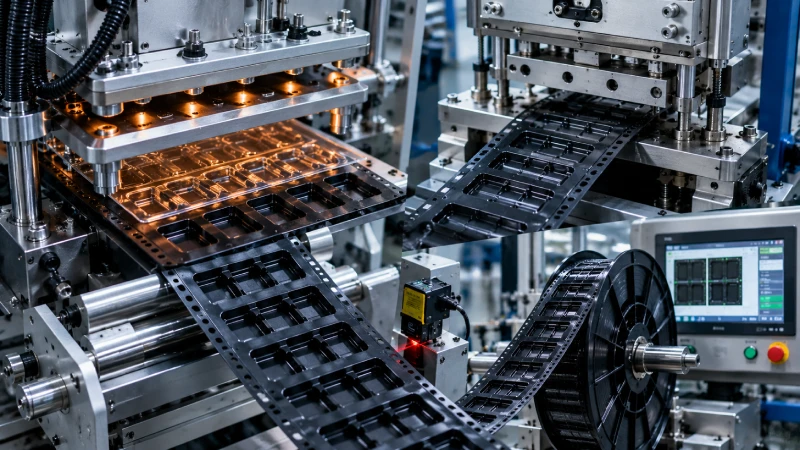
1. Raw Material Feeding
The process begins with plastic material feeding. Common materials include:
- PS (Polystyrene)
- PET
- PC
- Conductive anti-static materials
The material is usually supplied in roll form and fed continuously into the forming system.
Material selection depends on:
- Component sensitivity
- ESD requirements
- Packaging strength
- SMT feeding stability
Conductive carrier tapes are especially important for semiconductor and IC packaging applications.
2. Heating and Thermoforming
The plastic material passes through controlled heating zones where it becomes soft enough for forming.
The machine then uses:
- Vacuum forming
- Pressure forming
- Precision molds
to create embossed cavities.
This stage is the core of the entire carrier tape production process.
High-quality forming machines maintain:
- Stable temperature control
- Uniform cavity depth
- Consistent pitch accuracy
- Minimal deformation
For manufacturers seeking stable embossed tape production, the Carrier Tape Production Machine for Embossed Tape Forming is designed specifically for precision carrier tape manufacturing applications.
3. Sprocket Hole Punching
After cavity forming, sprocket holes are punched into the tape.
These holes are critical because SMT pick-and-place feeders use them to advance the tape accurately during automated assembly.
Poor hole positioning can cause:
- Feeding instability
- Machine jams
- Misalignment
- Production downtime
Modern carrier tape forming machines use precision punching systems to maintain compliance with EIA standards.
4. Inspection and Rewinding
Once the tape is formed, it is inspected and rewound.
Advanced systems may include:
- Vision inspection
- Defect detection
- Tension monitoring
- Automatic counting
Inspection helps reduce scrap rates and ensures packaging consistency before the tape enters final packaging processes.
Manufacturers looking for integrated inspection capabilities may consider the Semi-Automatic Visual Inspection Carrier Tape Packaging Machine to improve quality control during production.
Main Types of Carrier Tape Forming Machines
Not every production environment requires the same level of automation. Choosing the right machine depends on output volume, product complexity, and budget.
Semi-Automatic Carrier Tape Forming Machines
Semi-automatic systems are ideal for:
- Small-batch production
- Flexible manufacturing
- R&D projects
- Frequent mold changes
They offer lower investment costs and greater operational flexibility.
For manufacturers with moderate production requirements, the Semi-Automatic Carrier Tape Packaging Machine provides an efficient solution for carrier tape packaging operations.
Fully Automatic Carrier Tape Production Systems
Fully automatic systems are designed for:
- High-volume production
- Stable long-term operation
- Reduced labor dependency
- Higher production efficiency
These systems often integrate:
- Forming
- Sealing
- Inspection
- Reeling
into a continuous automated workflow.
For large-scale SMT packaging production, the Fully Automatic Carrier Tape Packaging Machine can significantly improve productivity while reducing operational costs.
Integrated Packaging and Reel Handling Systems
Some manufacturers also require downstream automation equipment such as reel changing systems and pallet transfer solutions.
These integrated systems help:
- Reduce manual handling
- Improve production continuity
- Increase automation levels
For example, the Plastic Reel Changing Machine for Tape & Reel Packaging helps automate reel replacement during high-speed packaging operations.
Key Specifications Buyers Should Evaluate
When selecting a carrier tape forming machine, technical specifications directly affect production performance.
Supported Tape Widths
A flexible system should support multiple tape widths, including:
- 8mm
- 12mm
- 16mm
- 24mm
- 32mm
- Customized sizes
Manufacturers serving different industries often require multi-width production capability.
Forming Speed
Production speed is usually measured by:
- Cavities per minute
- Meters per hour
Higher speed improves production efficiency, but stability is equally important.
A machine that runs fast but produces inconsistent cavities may increase scrap rates and packaging failures.
Forming Precision
Precision is one of the most important factors in carrier tape production.
Key parameters include:
- Cavity dimensional tolerance
- Pocket depth consistency
- Pitch accuracy
- Hole alignment precision
Poor precision can cause serious feeding problems during SMT assembly.
Material Compatibility
Different components require different carrier tape materials.
A good forming machine should support:
- Conductive materials
- Anti-static materials
- Transparent materials
- High-temperature materials
Material flexibility helps manufacturers serve a wider range of industries.
Mold Change Efficiency
Fast mold replacement is essential for manufacturers handling multiple SKUs.
Efficient mold design helps reduce:
- Downtime
- Labor costs
- Production interruptions
This becomes especially important for custom carrier tape production.
Why Embossed Carrier Tape Quality Matters
Carrier tape quality affects much more than packaging appearance.
It directly impacts SMT production efficiency.
Component Protection
Proper cavity design prevents:
- Component movement
- Physical damage
- Electrostatic discharge
Sensitive ICs and semiconductor components especially require stable cavity protection.
SMT Feeding Stability
Automated SMT feeders depend on precise tape geometry.
Even small dimensional inconsistencies may cause:
- Pick-and-place errors
- Feeding interruptions
- Line stoppages
Stable carrier tape improves overall manufacturing efficiency.
Packaging Consistency
Consistent packaging quality becomes increasingly important for high-speed automated assembly lines.
Manufacturers often use peel strength testing to verify sealing quality and packaging reliability.
The Carrier Tape Peel Strength Tester for Packaging Validation helps manufacturers ensure consistent sealing performance and packaging compliance.
Common Problems in Carrier Tape Forming
Even advanced production lines can experience manufacturing issues if process control is poor.
Inconsistent Cavity Dimensions
Common causes include:
- Mold wear
- Temperature instability
- Uneven material thickness
Regular calibration and maintenance help reduce dimensional variation.
Sprocket Hole Misalignment
Improper hole positioning can lead to:
- Feeder jams
- Positioning errors
- SMT downtime
Precision punching systems are critical for maintaining alignment accuracy.
Material Warping
Warping usually occurs because of:
- Improper heating
- Insufficient cooling
- Excessive tension
Modern machines use optimized thermal control systems to minimize deformation.
High Scrap Rates
Scrap can increase because of:
- Poor inspection systems
- Unstable production conditions
- Manual operation errors
Automated visual inspection systems help detect defects earlier and improve production yield.
How to Choose the Right Carrier Tape Forming Machine
Selecting the right equipment requires evaluating both current production requirements and future expansion plans.
Define Your Production Volume
Low-volume manufacturers may prioritize flexibility and lower investment costs.
High-volume manufacturers usually prioritize:
- Automation
- Stability
- Output speed
- Labor reduction
Consider Component Complexity
Different electronic components require different cavity designs.
Ultra-small or irregular components may need:
- Higher forming precision
- Custom molds
- Advanced inspection systems
Evaluate Automation Requirements
Automation helps manufacturers:
- Reduce labor costs
- Improve consistency
- Increase throughput
- Reduce human error
As Industry 4.0 adoption increases, more factories are investing in fully automated carrier tape production lines.
Assess Supplier Support
Reliable after-sales support is extremely important.
Buyers should evaluate:
- Technical assistance
- Spare parts availability
- Mold customization
- Remote troubleshooting
- Installation support
Long-term equipment stability often depends heavily on supplier service quality.
Future Trends in Carrier Tape Forming Technology
The carrier tape industry continues evolving alongside semiconductor and SMT manufacturing.
Future trends include:
- AI-powered visual inspection
- Smart defect monitoring
- Higher-speed automation
- Industry 4.0 integration
- Eco-friendly packaging materials
Micro-adhesive sealing technologies are also becoming increasingly popular for specialized packaging applications.
The Micro-Adhesive Carrier Tape Packaging Machine supports advanced sealing requirements for precision electronic packaging.
Conclusion
A carrier tape forming machine is a critical part of modern SMT packaging production. From cavity precision and sprocket hole accuracy to automation efficiency and inspection capability, every aspect of the machine directly affects packaging quality and SMT line performance.
As electronic components become smaller and production demands continue increasing, manufacturers need reliable embossed carrier tape production systems that can deliver stable, high-precision output at scale.
Whether you are building a new SMT packaging line or upgrading an existing production system, choosing the right equipment can significantly improve:
- Packaging consistency
- Production efficiency
- SMT feeding reliability
- Long-term operational costs
If you are looking for professional tape & reel production solutions, you can explore Jiushuo carrier tape packaging machines here to find suitable systems for embossed carrier tape production, automated packaging, inspection, and reel handling.